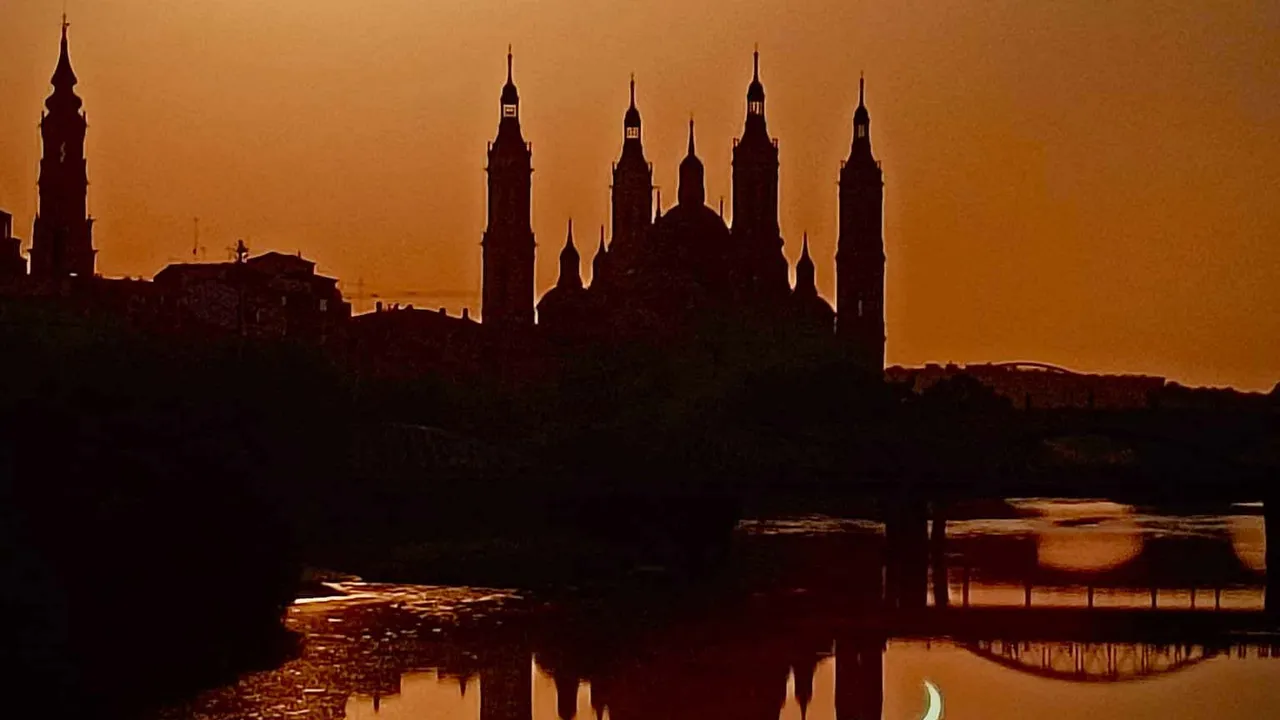
Before writing this article, I do a quick search on Google. Some journalist—our resources, references, and imagination are limited—will surely have titled a piece about the eclipse with a nod to The Mysterious Star of Tintin. I can’t find it, and yet I’m surprised. The tenth album of the series created by Belgian cartoonist Hergé begins with the sighting by the sprightly reporter of a star unusually large. As the days pass, its size increases and temperatures soar, causing the population to begin fearing the end of the world. Climbing the hills of Zaragoza’s Labordeta Park yesterday, the sun burned our skin in such a way that it seemed to be moving closer to our insignificant and noisy lives. “The Mysterious Star,” we said in unison, my father and I, while at the same time finding a reference that made us both smile, a 1942 comic, one of those things for which humanity, after all, perhaps does not deserve to be wiped from the face of the Earth by a meteorite.
The phenomenon we experienced yesterday afternoon in Spain, the first total solar eclipse visible from the Iberian Peninsula in more than a century, has stirred in the days that followed (weeks, months, how long have we been talking about this darn eclipse?) all kinds of emotions, deftly gathered, amplified and even provoked by the media. The clickbait is everything and, with astonishment, we have witnessed “journalistic” coverage that we wish we had never seen. In WhatsApp groups, the conversation dissected the matter with passion, even if only to declare skepticism or to laugh at those who were yesterday trapped in predictable traffic jams or paying ridiculous sums for a luxury box. Can we blame people for living with passion for something, whatever it may be? I won’t be the one to do so.
With a few friends, we were joking: “All this to see… the sun?” The safety measures about how to enjoy this phenomenon made me a little nervous; was the risk worth it? My teenage son had the blunt and indignant reply: “Why wouldn’t we go to see it?” I have a great respect for the scientific curiosity and the intuitive sense that children possess. Where I only see risks and things that “maybe aren’t worth it,” they see the universe, life, the order (and disorder) of things. And given that we were yesterday in the Aragon capital, one of the privileged spots to witness how the shadow of the Moon covered our mysterious and nagging star —what a hot summer this is, how all our happy places burn, though we could not blame the Sun for that…—, it was hard to stay on the sidelines.
It was a unique occasion and, as is often the case with things that move us most, there wasn’t a fully rational explanation for our reasons to want to be part of it. “Because of the oddity of the moment when the power goes out and then comes back,” pointed out my thirteen-year-old son. “An excuse to gather with family.” “To see the atmosphere and the anticipation.” “This dove will be our object of study,” pointed out my nine-year-old son, pointing to a tree, eager to witness how the birds changed their behavior.