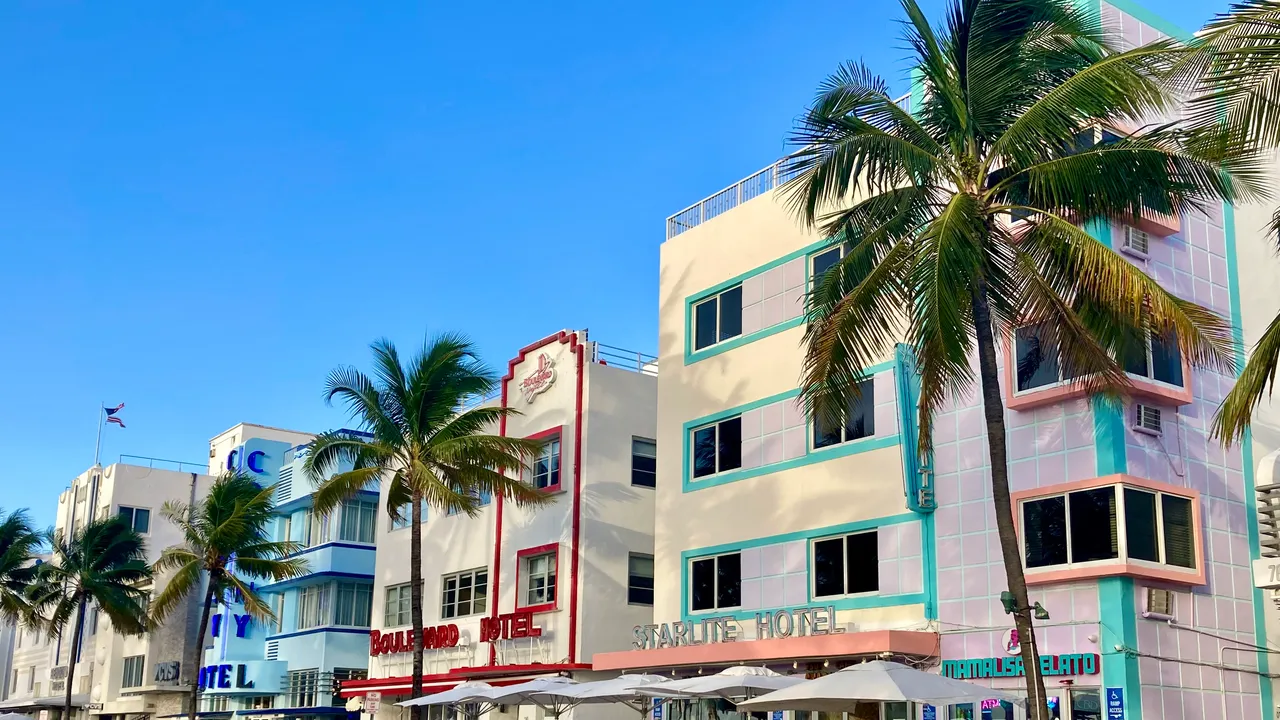
It’s all too easy to fall under Miami’s charms. She casts a flirtatious glance toward Miami Beach, inviting the most cinematic beachside hedonism; she struts down Calle Ocho, with those Cuban rhythms that lift the soul; she promises a life of success under the Brickell skyscrapers. Miami’s architecture is among the most recognizable. And yet the city has not even reached its two centuries of life.
It’s hard to imagine that its mega-urbanized land was not long ago a mangrove swamp, with alligators and mosquitos as its main neighbors. But when, at the end of the 19th century, a widow from Cleveland decided to start a new life on the lands she had inherited on the north bank of the Miami River, everything changed. Today the statue of Julia Tuttle, considered the Mother of Miami, gazes from Bayfront Park toward the city’s historic center, the Downtown, confirming that her dream of building a great city had come to life.
Downtown: The Beginning of It All
That the main street of Downtown is called Flagler Street is no coincidence. Convinced of the place’s potential, the lady Tuttle was the one who convinced magnate Henry Flagler to bring here his railroad line, which was already underway along the East Coast. And indeed, if the train arrived, tourists and new residents would follow. It worked. The Florida East Coast Railway reached Miami in April 1896 and Miami was officially incorporated as a city on July 28.
Perhaps not the most vibrant area of Miami, but Downtown is the perfect place to recognize the layers of Miami’s history. It was here that the first travelers of that train began arriving, finding lodging, quite by chance, in the hotel raised by Flagler himself, the Royal Palm Hotel, a modern behemoth that already boasted elevators, electricity and even a pool. Drawn by its pleasant climate, Miami in 1897 was already beginning to resonate as a tourist destination.
Her image of an idyllic tropical destination was brought into fashion by Burdines, a brand that made the Burdine Building, built in 1912, a true commercial emblem. The five-story building with a curved corner profile still stands. A few years later, Miami unveiled the Ralston (1917), at the time the tallest building in Miami, with eight stories. Yet it is the Freedom Tower, erected in 1925, that became one of the city’s first major skyscrapers. The building that once housed the newspaper The Miami News rose during Miami’s first Golden Age, the 1920s, with a neomediterranean design that was very fashionable at the time. It won’t be the only building in the city that recalls the Giralda. Beyond its architecture, this place is key to telling another of Miami’s pivotal moments: its interiors, during the sixties and seventies, served as a processing center for Cuban refugees, earning it the nickname the Ellis Island of the South. Today it operates as a cultural center and museum of Miami Dade College, the city’s public university. It is worth visiting.
The recovery from the fateful 1929 crash is embodied by Alfred I. duPont. In 1939 this bank opened its doors with a spectacular lobby that still preserves the original marbles, as well as the painted ceilings and the brass grills of the teller windows. Today it is only visitable thanks to private tours or events like annual Open House Miami. And while one might speak of Miami as a financial epicenter, it’s better to move on to the neighboring Brickell.