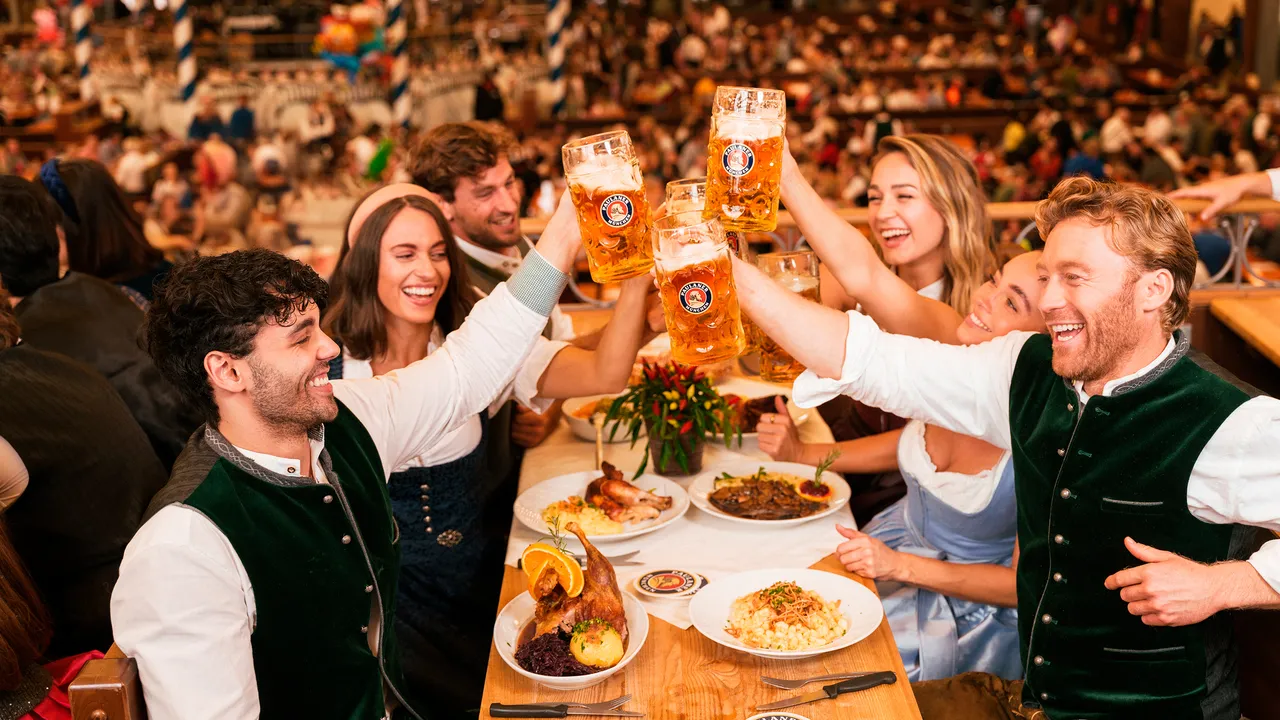
In the popular imagination of our country, Germans aren’t exactly the poster children of “good vibes”: the image we have of our German neighbors tends to be serious, meticulous, and even brusque… except at Oktoberfest. We’ve all seen those pictures of burly Germans with huge smiles and even bigger mugs, dressed in their colorful Bavarian outfits, making merry to the polka at long tables that look like something out of Game of Thrones. But how much of that is true and how much is marketing? I’ve just returned from my first Oktoberfest in Munich, so I’ve experienced firsthand what this autumn festival is, what it isn’t, and everything I wish I’d known. Stay with me and I’ll tell you.
Oktoberfest… in September?
The most famous festival in Bavaria has its origins in 1810 with the marriage of King Ludwig I and Princess Therese of Saxony-Hildburghausen on a meadow on the outskirts of the city that came to be known as the Theresienwiese (a statue of Therese still guards the festival to this day). The region’s farmers decided to repeat the celebration as a way to showcase their achievements to the rest of Bavaria, and after a few turbulent years of Napoleonic wars and the addition of attractions starting in 1818, the city of Munich took charge of organizing it.
In 1872 it was decided to move the celebration up to mid-September to take advantage of late-summer weather; from that moment, Munich’s Oktoberfest starts on the Saturday after September 15 and ends on the first Sunday of October. However, with rising temperatures in recent years across Europe and in Germany in particular—during Oktoberfest 2026 temperatures hovered around 20 °C (and 2025 saw a record 30.7 °C on the opening day)—many feel it may be time to return the festival to its original month of celebration. “It seems to me the festival will be back in October sooner rather than later,” joked Jörg Biebernick, CEO of Paulaner, during a chat we had with him at the festival.