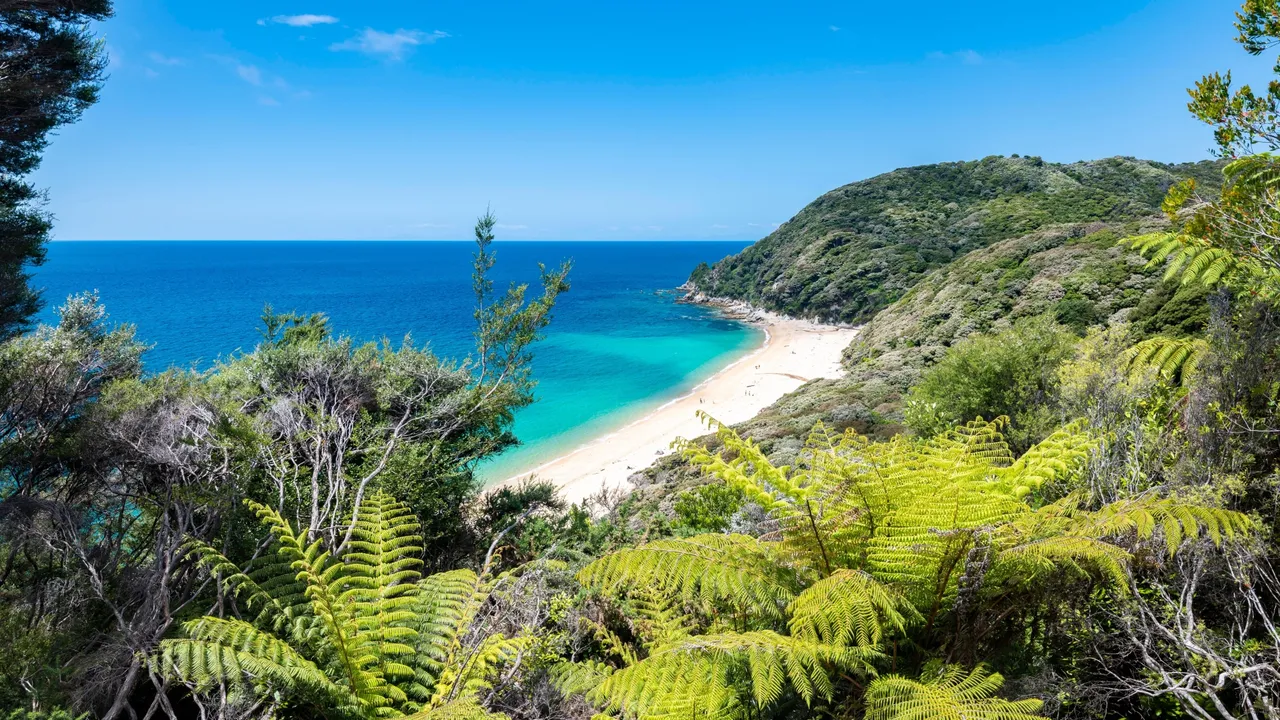
Abel Tasman National Park, located at the northern tip of New Zealand’s South Island, struck me as an unreal and utterly secluded place. When I visited it for the first time, its infrastructure wasn’t as developed as it is today, and I felt like a true explorer in unknown lands for humankind.
Between dense forests, suddenly there would appear completely deserted beaches where the golden sand was lapped by a sea that could be blue at the shore, green a little further out and gray as the seabed sank into unfathomable depths.
In the purest solitude, we felt fortunate. Exploring Abel Tasman and New Zealand – the country farthest from Spain – for a month wasn’t just any trip; it was the chance to witness a dream fulfilled that did not disappoint.
It’s hard to argue with the great filmmaker Peter Jackson for choosing his own homeland to bring Tolkien’s Middle-earth to life. After many years traveling the world, I too could not propose a better place.
Un parque nacido de un desencuentro
Although today the name Abel Tasman evokes paradisiacal beaches and forest excursions, its origin is marked by one of the tensest meetings in New Zealand history. The Dutch navigator Abel Janszoon Tasman arrived on these shores in December 1642, during his search for the mythical Terra Australis. On December 18 he anchored his ships off Wharewharangi Bay, in present-day Golden Bay, north of the park. There, the first known contact between Europeans and Māori occurred. A miscommunication and fear made it not very fortunate.
The Ngāti Tūmatakōkiri —the tribe that dominated the region at the time— approached in their canoes and performed ritual signals with their trumpets to see if the foreigners were friends or enemies. The Dutch responded, as a greeting, with their own trumpets and, finally, with the roar of a cannon shot. However, for the Māori that was a declaration of war.
At the next day, four men from Tasman’s crew died in a confrontation. The explorer decided to depart without having set foot on land and named the place Moordenaers Baij, ‘bay of the murderers’.