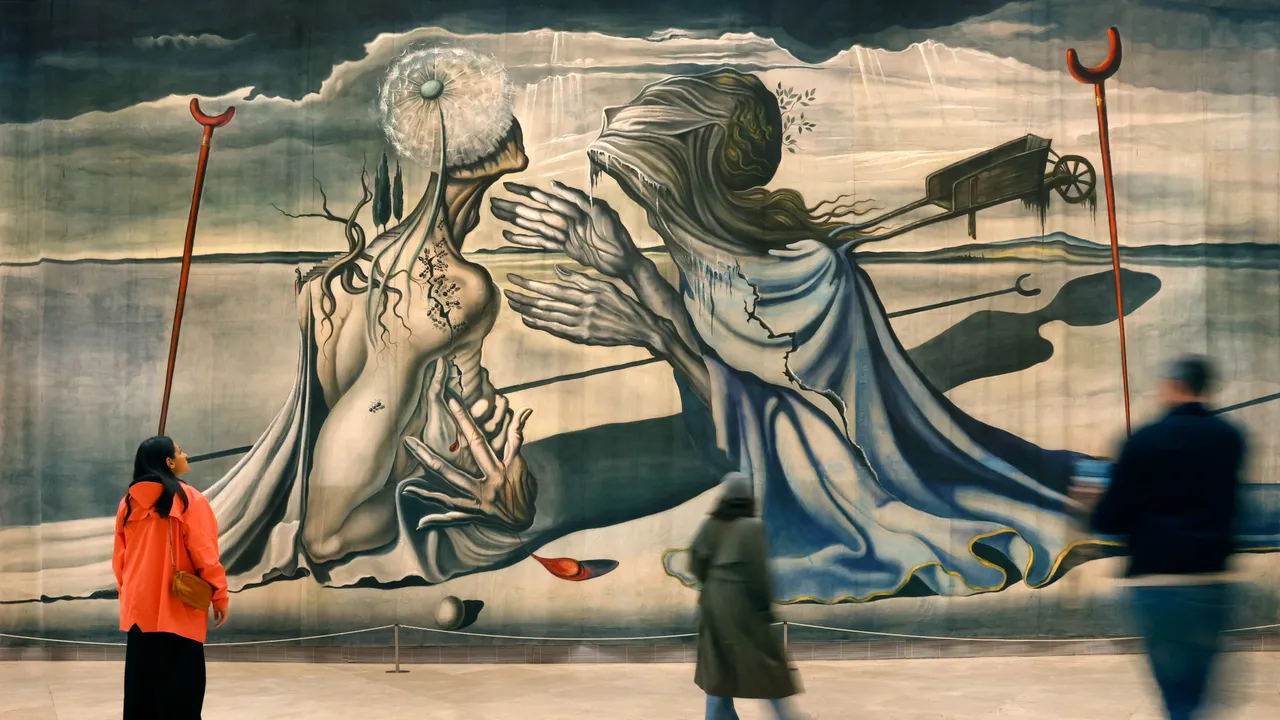
The Freudian Universe of Dalí. Freud’s legacy in the master of surrealism. The National Thyssen-Bornemisza Museum is beyond words. Curated by Jaime Brihuega, the museum’s galleries weave the relationship between Salvador Dalí’s (1904-1989) work and the writings of Sigmund Freud (1856-1939), in a journey that brings together the artist’s biography from the complex family world to his latest creations in Catalonia.
The exhibition, which has the collaboration of the Community of Madrid and the City Council of Madrid, and the sponsorship of Natixis Corporate Investment Banking, features more than 130 works, including paintings, sculptures, drawings and videos, from European and North American museums and institutions.
The Freudian Universe of Dalí is organized into six chronological sections around decisive chapters of his biography: The Family Environment, Figueres and Cadaqués; 1922-1928. The Residencia de Estudiantes. Return to Catalonia; 1929-1931. The Young Promising Surrealist; 1932-1937. The Paranoid-Critical Method; 1938-39. Meeting Freud. Expulsion from the Surrealist group and After 1940. the persistent shadow of Freud. Each of them focuses on Dalí’s works related to Freudian thought and is complemented by paintings and drawings by Jean-Auguste-Dominique Ingres, Gino Severini, Jean Arp, Kurt Schwitters, Federico García Lorca and Yves Tanguy, as well as by Santiago Ramón y Cajal and Freud himself.
The Freudian Universe of Dalí at the National Thyssen-Bornemisza Museum
Entering the first section of the exhibition provides an initial understanding of the painter’s complicated family environment. Works such as Portrait of Ana Maria (1924) and Figure at a Table (1925), among others, conceal stories such as the death of his mother when he was 17, and that of his brother Salvador, who died before his birth, as well as the authoritarian role of his father, who married his sister-in-law, who became his aunt-stepmother. Besides his family, during these years the sea, the beaches and the rocks of Cape Creus, in the surroundings of Cadaqués — Cliffs (1926) — left a strong imprint on the Catalan painter, whose silhouettes appear in many of his works.