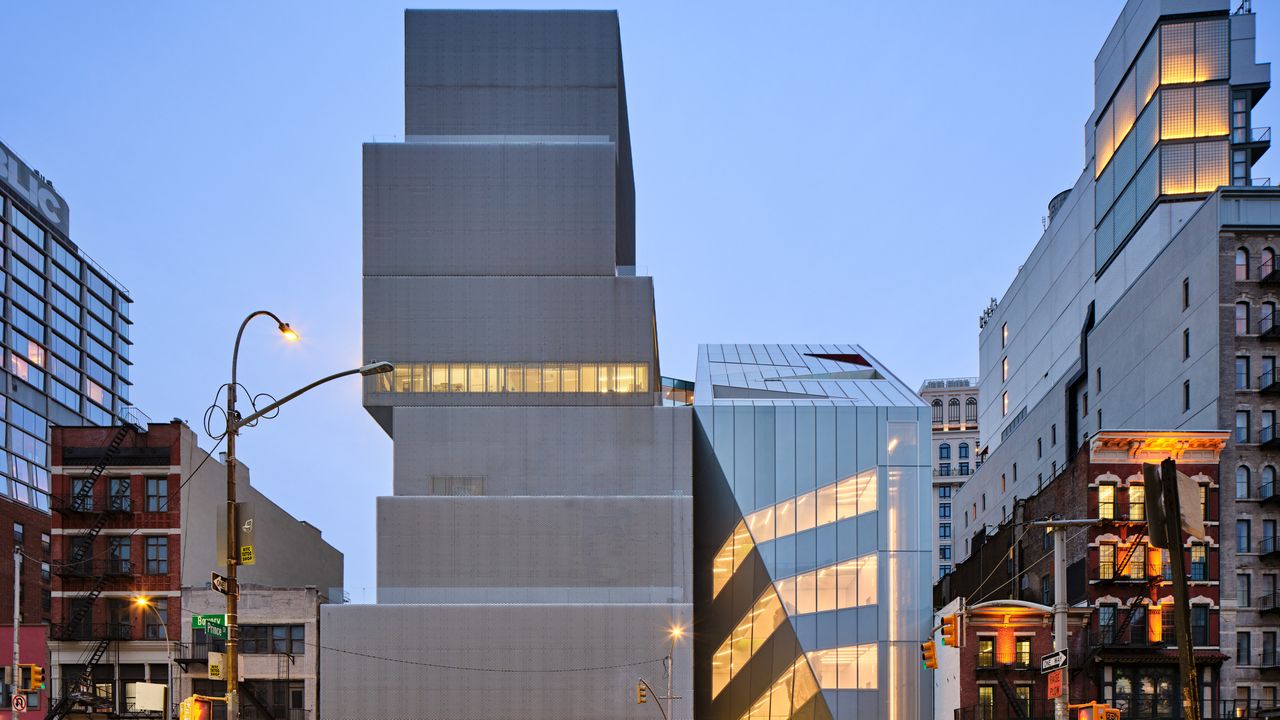
You may not have visited the New Museum yet, but we bet you’ve been extremely close. Surely you’ve wandered along Prince Street in Nolita, drawn by the slice from Prince Street Pizza or by the sweets from Little Cupcake Bakeshop. Or perhaps you were surprised by the queues at the Stüssy store or at the legendary Café Habana, where Mila Kunis and Justin Timberlake considered themselves just friends in the film Friends with Benefits. That same street, one of the prettiest in the neighborhood, leads you straight to the New Museum, whose apex rises against the asphalt horizon. It’s a postcard like no other that has just gained a new element.
This veteran cultural institution, nearing half a century in existence, has occupied several locations until, in 2007, it settled in its current headquarters on Bowery, one of New York’s most historic streets. By then, Lisa Phillips had already spent almost a decade as the center’s director and oversaw the first phase of the expansion, as she recounts during the reopening. “Shortly after the inauguration, we had the opportunity to acquire the adjacent building and five years later it was at capacity with resident artists, more galleries and centers for art and technology education.”
At that juncture, the most sensible course of action was to start from scratch and build a completely new structure that, as Phillips notes, “isn’t a new wing, nor an extension, nor an annex.” To achieve this, they enlisted the architectural firm OMA, which crafted a concept that goes beyond a mere art space, instead tying more closely its public function within the city. The new addition is distinct enough to have its own personality, yet it harmonizes seamlessly with its neighbor. Architect Shohei Shigematsu, who could monitor the construction with a telescope from his nearby studio, describes it this way: “They are the perfect pair; one vertical and introverted; the other horizontal and extroverted.”
The verticality Shigematsu references is immediately evident as you climb a spiraling staircase that embraces a monumental work by Czech artist Klára Hosnedlová. Titled Shelter, this metal structure wrapped in linen fabrics that yield a mossy texture reveals its interior as you ascend toward the galleries. Inside the exhibition spaces you will encounter around 700 pieces by more than 200 artists and creators from all corners of the globe across multiple disciplines, all speaking to what it means to be human in a world that is so technologically driven.