Some tongues say that the Matarraña comarca is comparable to the Italian Tuscany. But we can assure you that with every journey you undertake through those lands you will encounter more and more differences. In fact, you won’t find any resemblance to Tuscany. Because the Matarraña of Teruel has a distinctly own identity, forged over centuries of conquest and labor on the land.
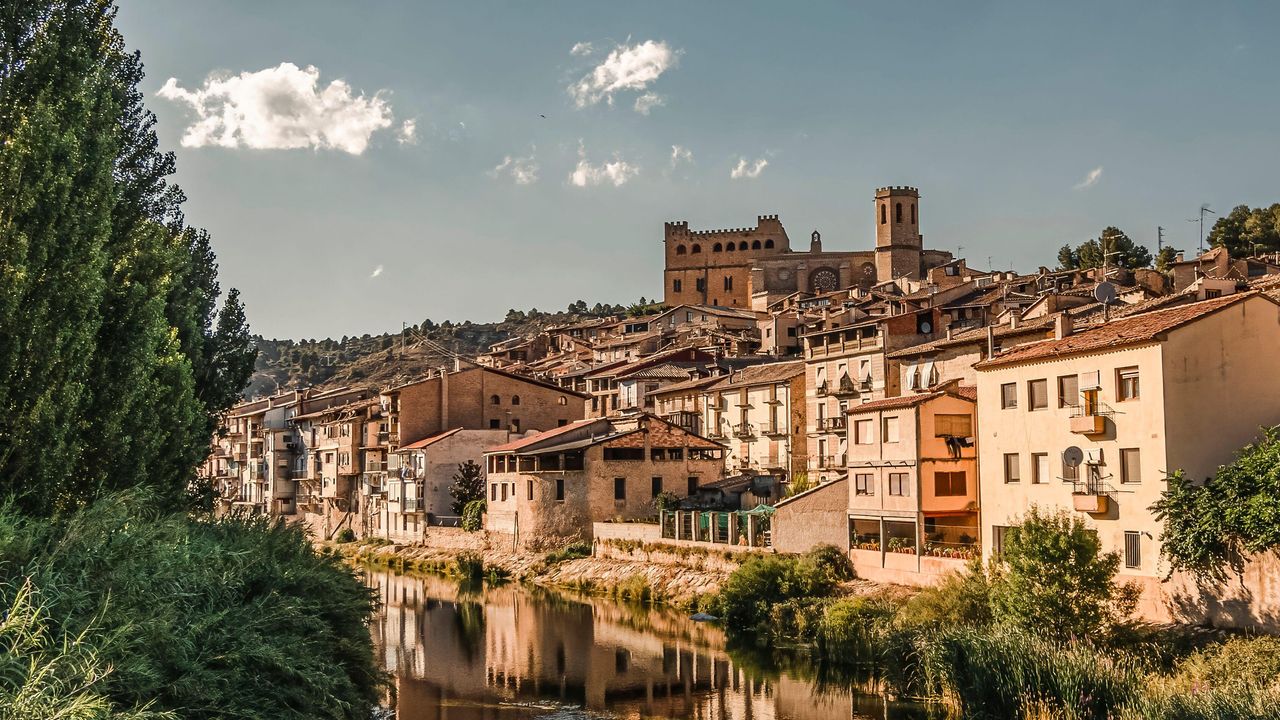
Determined to put an end to that silly likeness, we head to Valderrobres, the capital of the Matarraña comarca and a member of the club of Spain’s most beautiful villages since 2013. This medieval town is crossed by the same Matarraña River, which divides the city into two parts: on one side the new town and on the other the old town.
A Church’s Whim in the Matarraña
To get to know Valderrobres inside and out, it is important to be well informed. For this you can visit the Tourism Office, located in the new town, or venture into the upper part, in the old town, and book the guided group visits through Turismo Matarraña, a small organization located next to the town hall.
One way or another, the first step must always be taken from the 14th-century bridge that links the two parts of the city and gives access to the old town through the San Roque gate. It is the main entrance to the city and one of the seven ancient access points to the walled city, which was fully in use from the 13th century. It bears the name San Roque in honor of the saint who guards the entrance from a niche embedded in the turret of the gate.
When you look up, it’s easy to fall in love with the beauty of the medieval air that adorns every façade of the houses that open onto our path to Plaza de España. Directly to the left of this point lies Valderrobres’ town hall, a direct link to the city when it was brought into the fold of the Renaissance. The municipal building is more than just the administrative hub of the city, since on its ground floor it preserves a room that was part of Valderrobres’ dungeons. Although only one remains, it is known that the dungeon saw a great deal of activity during the Carlist Wars.
The next stop is the Museum and Interpretation Center of Valderrobres, but to reach it one must thread through the tangle of lanes and passages that make up the medieval layout of this Teruel village. Some of the noble houses hint at origins of great pedigree, with a certain pomp perhaps somewhat faded, as if signaling that in days past they were inhabited by families who celebrated in grand fashion, with noble surnames and large banquets every week.