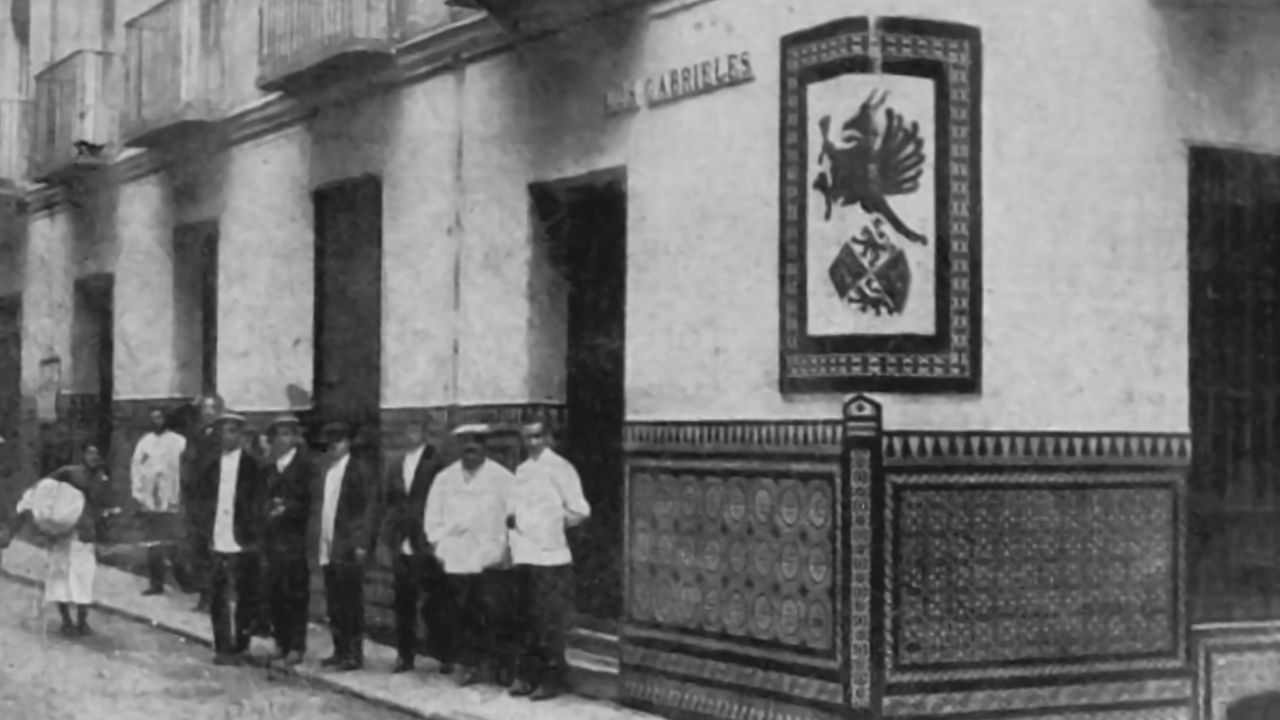
In Los Gabrieles, the night turned into day to the rhythm of claps and the ripping of a Spanish guitar. There was no tablao (at least in its early days), but there were intimate concave salons tucked away in the basement of the quintessential Madrid of Las Letras. Here the crème de la crème of flamenco would parade for the pleasure of intellectuals, fashionable socialites, celebrities, and the musicians of the moment. In fact, it is said that Alfonso XIII himself had his own entrance so that no one would know when he entered… and even less when he left. Ava Gardner and Hemingway also fell under its spell, as did Miguel Hernández, Valle-Inclán, or Azaña. A few decades later, a still-aspiring actor named Javier Bardem would work as a waiter for a season, and Joaquín Sabina would mention the place in De purísima y oro.
There are places whose walls hold so much history that recounting it all at once becomes impossible. It must be delivered in little sips, as is the case with this iconic spot on Calle Echegaray, whose walls shelter anecdotes from throughout the 20th century. An Andalusian tavern par excellence, the heart of flamenco, a witness to Madrid’s nocturnal revelry, it is curious to discover that Los Gabrieles was born with a more prosaic objective: popular take away dishes at 30 or 50 céntimos de peseta.
The Visionary’s Bet
The Aragonese journalist Rafael José Jimeno Vizarra lacked hospitality know-how, but he possessed ample charisma in public relations and a shrewd business sense, which he displayed when he dared to open a new concept of ‘restaurant’ in 1907.
Already there were places to enjoy castizo cuisine – by then they were already serving their famous stews at Malacatín or Lhardy – but their prices were not within everyone’s reach. To cut costs and offer an affordable product for Madrid’s working class in the early 20th century, Rafael found the key in something as common today as it was then: opening a place that exclusively operated for take-away. Dispensing traditional dishes that he cooked in a large cauldron, this format allowed him to lower costs, presenting, as the newspaper El Imparcial noted, a place where “the worker will have his meal there secured for half the price it would cost to simmer it in his poor home and infinitely better in quality and seasoning.”