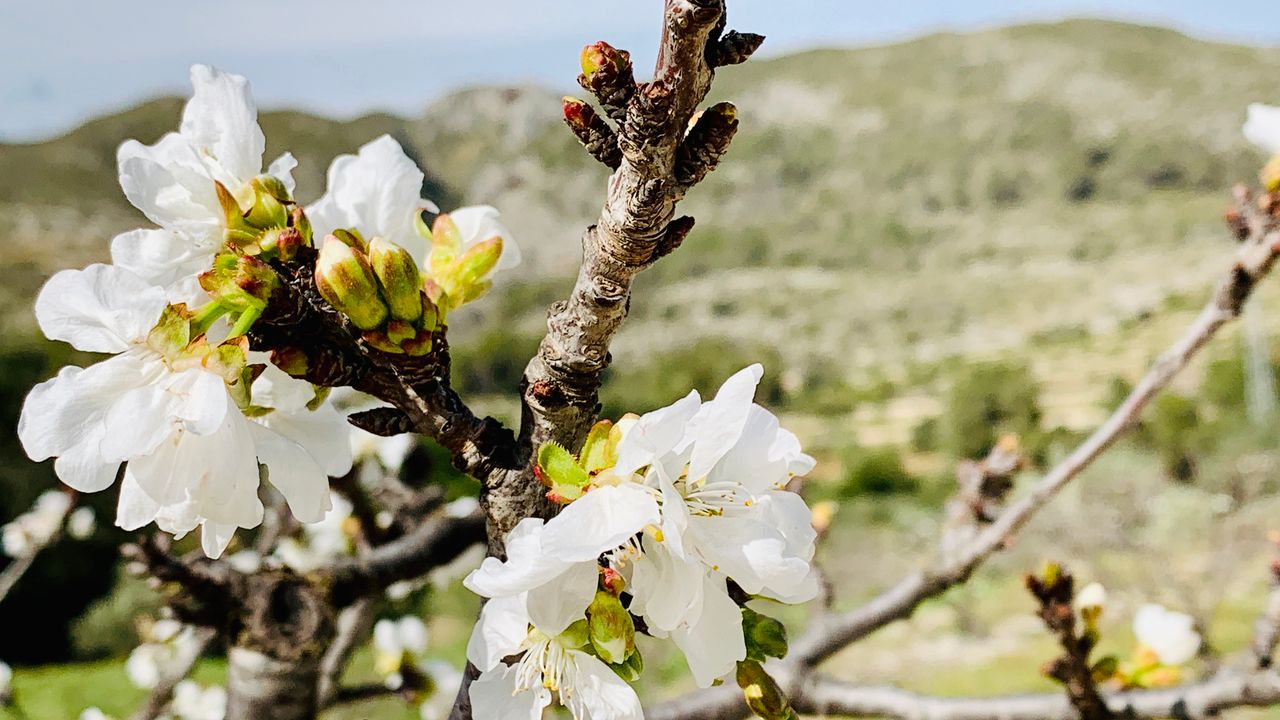
It was the year 2020 when, in this magazine, we declared La Vall de Gallinera as the best spectacle of blooming cherry trees in Spain. At that time, only a few people knew this beautiful municipality made up of eight villages and barely 600 inhabitants. But as the years go by, it has become an open secret that, for many, is a date marked on the calendar.
When springtime arrives and the weather turns pleasant, this fertile land of the Alicante valleys fills with outsiders eager to immerse themselves in the rosy bloom. Its cherry trees usually blossom between mid-March and early April, in a fleeting spectacle that lasts between 7 and 12 days, dyeing the valley white.
Why are there cherry trees in the Vall de Gallinera?
Cherry trees require a temperate climate with cold winters, an altitude between 200 and 800 meters, and a minimum annual rainfall of 600 mm. All of these conditions are met in the Vall de Gallinera in an ideal way, which explains their cultivation in this area.
In fact, the valley, situated in the Marina Alta, has a long tradition of cherry cultivation. Its foundations were laid by the Muslims in the Andalusian era, when they introduced advanced agricultural techniques to the region and began planting the first trees. This tradition has endured thanks to inherited practices refined over time, such as manual pruning and the terracing of the hillside lands.
Moreover, in the 16th century, as the cherry began to gain economic and cultural importance in the area, “cherry” and “Vall de Gallinera” became, practically, synonymous. Since then, its production has been a driving economic force for the region, especially due to the unique sweetness and quality characteristics of the fruit grown here.
Additionally, the Vall de Gallinera is known for producing one of the earliest cherry harvests in Europe thanks to its favorable microclimate, which not only yields delights on the table but also offers an incredible visual spectacle each spring.
What to do in the Vall de Gallinera?
This area cannot accommodate so many visitors, and even the few viewpoints there are do not have parking space enough for more than a handful of cars. The solution, therefore, is to enjoy the journey. “Since it is a long valley, any point is good for admiring the fields simply by driving along the road,” advise the council. Walking is also an excellent option for hiking enthusiasts.