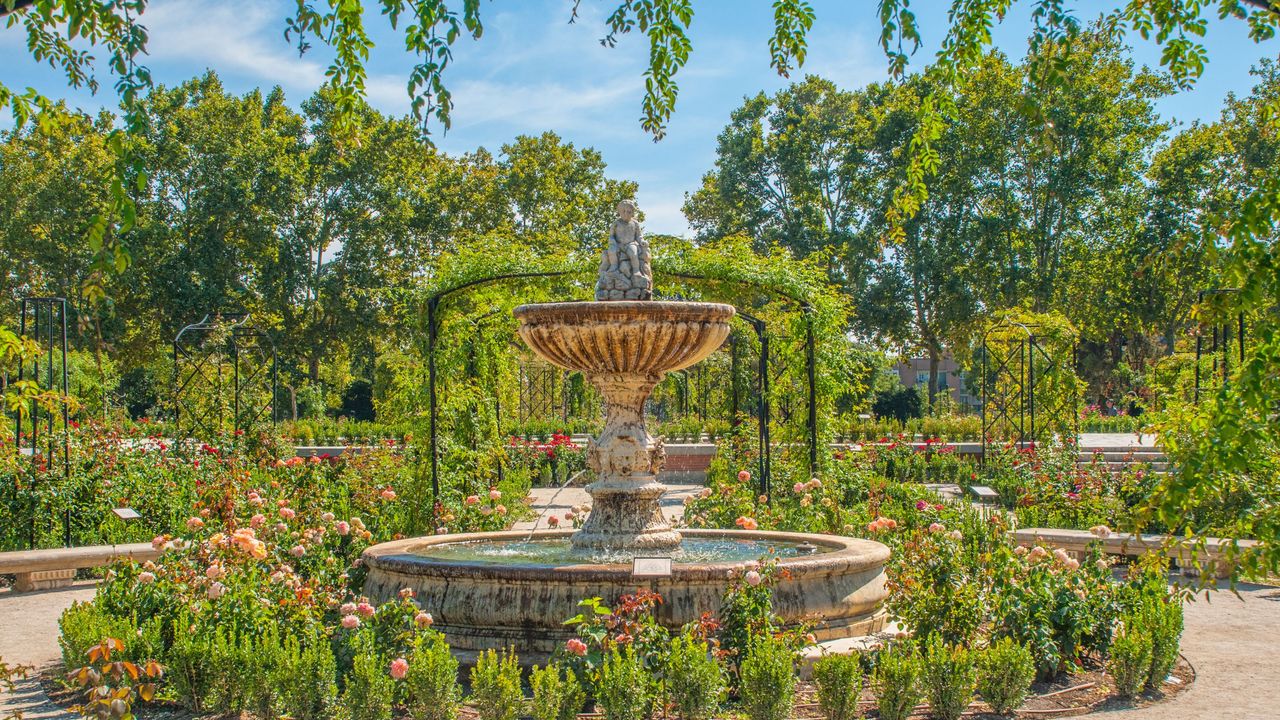
With this wild weather that climate change brings us year after year, it becomes harder to believe that May is the month of flowers. Because we have flowers from April and well into June. And it is in these months that strolling through Madrid’s historic gardens becomes quite an experience. Not all of them are as old, nor are they all as famous.
El Capricho
In Alameda de Osuna, very close to Barajas, lies one of the city’s most beautiful historic gardens that, for some reason, many people don’t know about. El Capricho Park was ordered to be built by María Josefa Pimentel y Téllez-Girón, the duchess consort of Osuna, around 1784. It took so long to complete that neither the duchess nor her husband could see it finished. It is the only Romantic garden in the city, and to make the most of it you need almost a full morning.
The garden is divided into several zones. In the French Garden, among statues of mythological figures, lies the Plaza de los Emperadores and the beautiful fountain “the Pearl Necklace”, nicknamed so for the similarity between the pearls and the droplets of water that fall from the fountain. The Italian Garden gives access to the hedge maze that precedes the Palace of the Dukes of Osuna and the powerful fountain of the dolphins. Additionally, in the gardens there are an apiary, a ballroom, a swan-filled lake, and even a bunker. The latter can only be discovered through a guided tour.
The Prince of Anglona’s Discreet Garden
It is another of Madrid’s treasures that passes largely unnoticed. Moreover, many of those who mingle and terrace around the central barrio de La Latina don’t know that in the Plaza de la Paja sits this small green oasis. Some may have noticed the riot of climbing plants that slither along one of the garden’s walls, the one facing Segovia Street. It was designed following the neoclassical canon that prevailed in Madrid in the eighteenth century, adjacent to the Palace of the Prince Anglona and the Chapel of Our Lady and of Saint John of Letrán, until recently owned by the House of Alba.
Acacias, fig trees, boxwood hedges and the occasional strawberry tree mingle in this curious composition that has remained intact for almost a century. Some twisted roses in crimson and fuchsia cling to the metal galleries that surround the central square, where a granite fountain shaped like a flower presides. Hidden on one side is a lovely wrought-iron gazebo, the photo corner that many people seek for the perfect shot.