A profile of Grace O’Malley: her life and enduring legacy
Throughout the annals of Ireland, women stand at the center of countless tales. From queens to fighters, rebels, saints and outright legends, stretching from ancient Celtic myth to concrete historical figures whose deeds and bravery helped shape Ireland as we know it today. This exploration of legendary Irish women pays tribute to the extraordinary women who have shaped Ireland’s imagination and sense of self.
Who Was Grace O’Malley?
Gráinne Ní Mháille, better known in history as Grace O’Malley, was a respected Irish chieftain of the 16th century, living roughly from 1530 to 1603. Frequently called the ‘Pirate Queen,’ she was not only a clan leader but also a sea captain and insurgent who commanded the O’Malley clan from their bases in County Mayo.
Grace’s father led the Clew clan, a seafaring lineage that controlled the waters near Achill island for more than three hundred years, collecting tolls from every passing vessel. While Grace had an elder brother who, under Brehon law, would have inherited their father’s position after his passing, Grace was nevertheless granted the title upon his death thanks to her persistence and leadership abilities. To circumvent the Brehon law which typically barred women from legally inheriting a chieftainship, she relocated her base to Clare Island and personally built a formidable, multi-force clan there.
In the early years of her tenure she was allowed to rule and assert control as she saw fit; however, her growing pirate activities soon drew the attention of Queen Elizabeth I. At that time Ireland was under English rule, and Grace’s two sons and her half-brother were captured by Sir Richard Bingham, the English Governor of Connaught, and imprisoned in Athlone Castle on charges of treason. Bingham also employed a scorched-earth tactic to punish Grace, seizing her lands and destroying her fleet.
Determined to obtain justice and secure the release of the three captives, Grace sailed to England, where it is believed she confronted Queen Elizabeth I and refused to bow before her in broad daylight or acknowledge her as Queen of Ireland. She reportedly declared that she governed her own territories as a sovereign queen, not as a subject of the English crown. It is also claimed that a knife was discovered concealed within Grace’s clothing before the meeting.
The conversation occurred in the only language they both shared, Latin, and Grace succeeded in securing the release of her family, with the queen reportedly agreeing to remove Bingham from his post. Nevertheless, it is believed Grace subsequently reneged on that portion of the agreement.
Grace’s successes and private life
During her lifetime, Grace commanded a private force of around 200 men and a substantial fleet. She also vigorously defended her territories against rival Irish clans and the advancing forces of the English Tudor conquest. She married twice, first at about 15 to Dónal O’Flaherty, a formidable neighboring chieftain-elect. He was slain in battle, after which Grace took control of his fortress (known as Hen’s Castle) and defended it against attacking rivals. Her second marriage occurred in 1566 when she strategically wed Richard Bourke to expand her realm and seize strongholds like Rockfleet Castle.
Grace returned to her homeland in County Mayo and continued to oversee her maritime domain well into her later years. In fact, records indicate she led a retaliatory naval raid at the age of 67. She passed away at Rockfleet Castle in 1603, the same year as Queen Elizabeth I.
Grace’s enduring legacy
Grace challenged both English domination and the expectations placed on women, and her legacy remains resonant today.
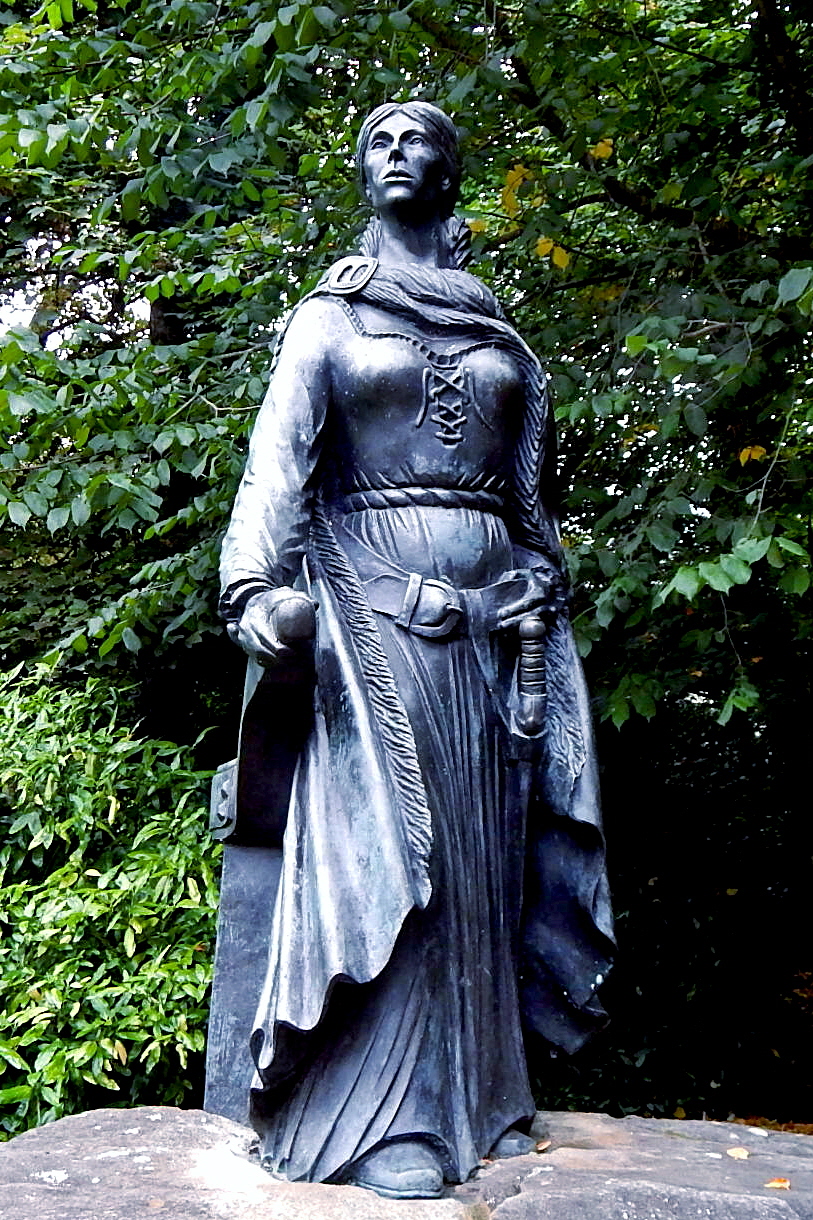
Today, her trailblazing legacy is preserved through meticulous historical records. She is remembered not merely as a western Irish figure but as a global emblem of female empowerment and national pride for the entire nation. The Cistercian Abbey on Clare Island, which still bears the O’Malley coat of arms, remains a key historical site where she is believed to be interred. A prominent bronze sculpture standing 7 feet 4 inches tall, created by artist Michael Cooper, also adorns the grounds of Westport Estate to honor her leadership.
Her name, Grace O’Malley, also adorns many residential areas in Howth, Dublin, such as Grace O’Malley Drive, reflecting her ties to the region. In the 1570s, it is said that Grace abducted the heir of Howth Castle after being denied hospitality by Lord Howth. She returned the boy only on the condition that the castle gates never be closed at mealtimes and that an extra seat always be left for unforeseen guests.
She is also remembered through literature detailing her legacy. A major dramatic television series centered on her history is in production, co-developed by Oscar-nominated director Kirsten Sheridan. She remains the subject of numerous traditional Irish folk songs – most famously the classic ballad Oró Sé do Bheatha ’Bhaile.