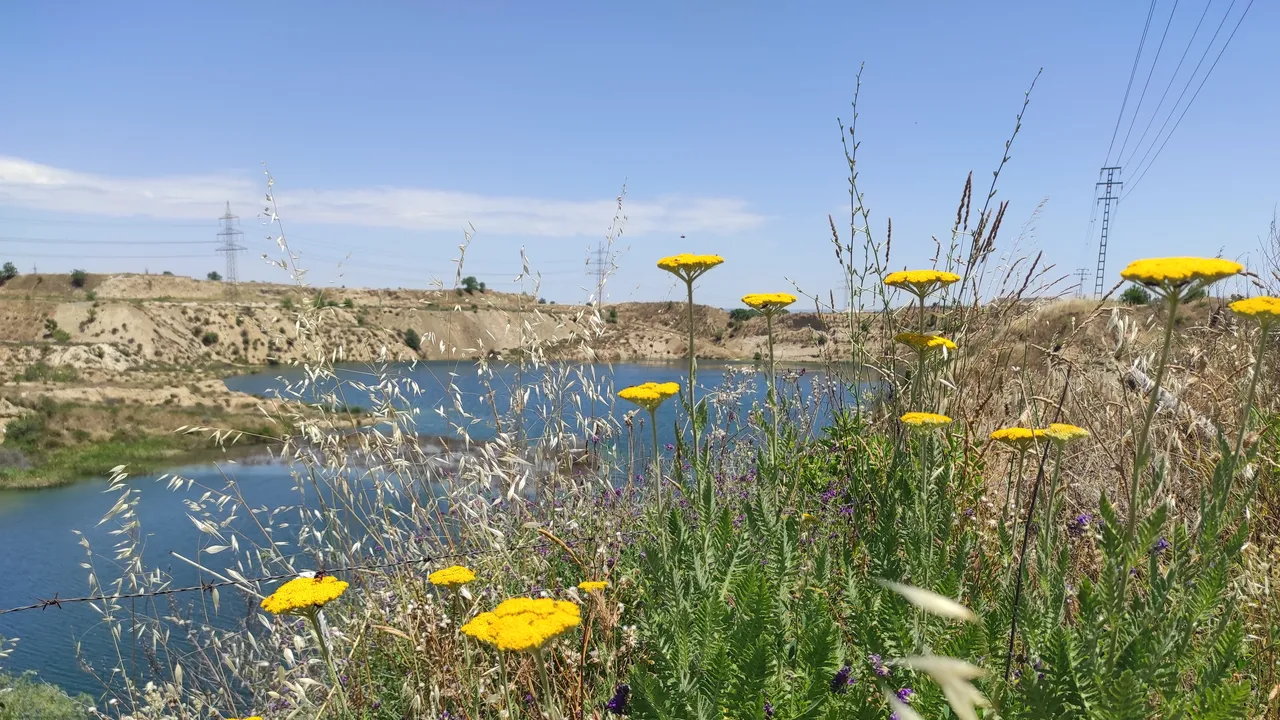
To the east of Madrid’s capital, in the district of San Blas-Canillejas, a postcard-worthy scene clashes violently with the industrial area, the trucks and the debris dumps that surround it: a large body of water, surrounded by escarpments, as if a stretch of the Hoces del Río Duratón had suddenly teleported there a stretch of the Hoces del Río Duratón. They are the Ambroz Lagoons, in plural, since alongside this main lagoon there are smaller, permanent ones, and various temporary pools. All you need is to follow the directions on Google Maps to reach this peculiar and, until recently, overlooked enclave.
Obviously, these lagoons did not come into being by magic. The Tolsa mining company obtained in 1977 a permit to extract sepiolite there for 30 years (a versatile mineral used from making cat litter to in nanotechnology). In 2007, once the contract had expired, extraction stopped, and the holes that had been dug into the ground were gradually filled with water from the groundwater level. For almost two decades, the site underwent a renaturalization process that soon drew the attention of neighbors, scientists and ecologists.
The first data were collected in 2016 by a group of entomologists. Between 2020 and 2022, other groups of zoologists, botanists and ecologists completed the work and published the Biodiversity Report, which showed that there inhabited there 1080 invertebrate species, 156 bird species, 13 mammal species, 449 plant taxa, 11 different herpetofauna species, and 55 fungi.
It was a strategy to try to prevent Tolsa from exploiting the area again, as they had requested in 2019. In March 2018, the Ambroz Lagoons Protection Plan for the protection, conservation and restoration was approved, which opened a door to modifying Madrid’s General Urban Plan so that the site would be declared of environmental interest. An official designation as a protected natural space was unsuccessfully sought, and a battle began among neighbors, ecologists, politicians and businesspeople to decide its future. In April 2026, the Community of Madrid approved an extension of the mine under the promise that, at the end of the exploitation in 2037, it will create new permanent lagoons.