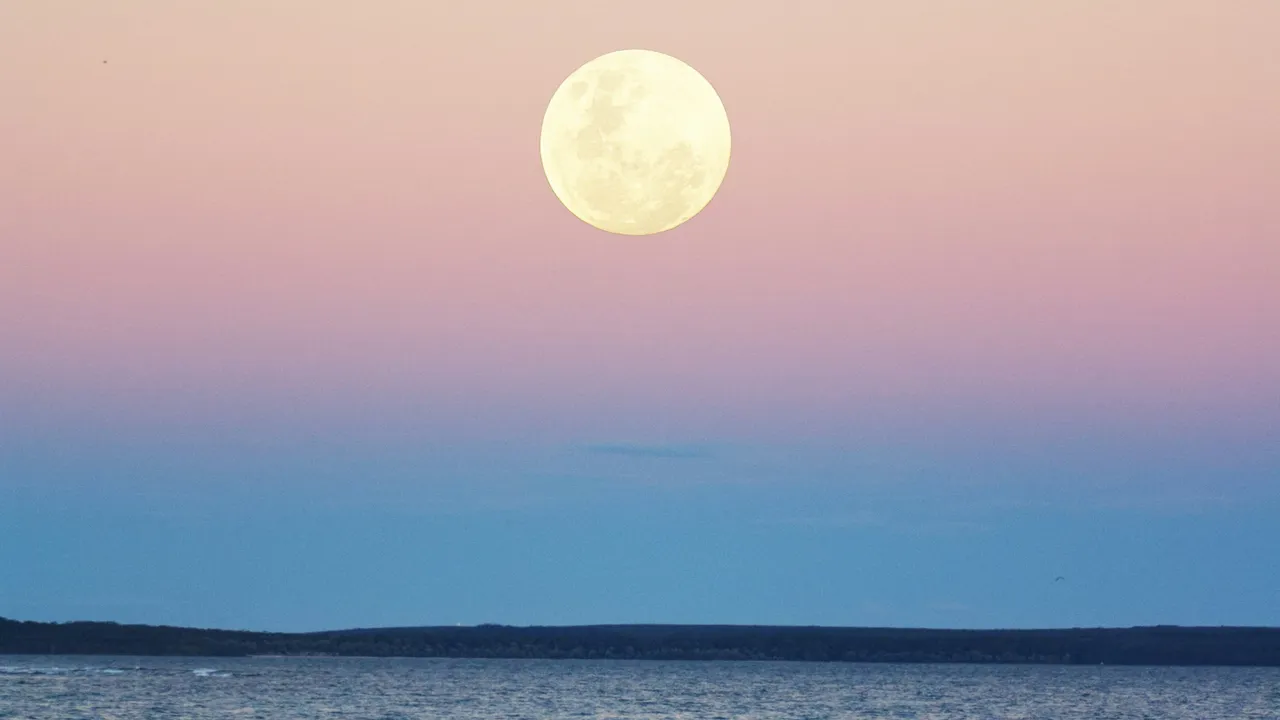
According to the 2026 astronomical calendar, which never stops giving us good news and surprises—such as the eagerly awaited total solar eclipse that will occur on August 12, and which in the Iberian Peninsula we will be able to see like nowhere else in the world—this May will bring two full moons. The first of them, the Flower Moon, took place last Friday, May 1 at 7:23 PM, but the second, the Blue Moon, will appear on May 31 at 10:46 PM.
The Flower Moon is one of the year’s most anticipated events, because it coincides with pleasant weather and allows experiencing it without the chill, although this year in some parts of Spain, due to the weather, it has not been possible to admire it in all its splendor. Will there be better luck with the Blue Moon? The full Moon of May 31, which will also be a micro-moon, can be seen across Spain, though with high temperatures, as confirmed by AEMET.
Therefore, we will be able to see the Blue Moon this year in the sky, albeit not in a literal sense, for this moon will not appear blue. It is called blue because, traditionally, the second full moon that occurs within a single month is referred to as the Blue Moon.
On the other hand, as the National Astronomical Observatory states, there will be more celestial events on that day. “Before bidding farewell to the month, on May 31, a few minutes before sunset, we will be able to enjoy Mercury, Venus and Jupiter on the western horizon, as the three planets traverse the constellation of Gemini.”
Instagram content
Why will there be two full moons this May?
As we’ve already explained, May will host two full moons—the second and third of spring—a remarkable fact because this year instead of 12 full moons we will have 13. Why does this happen? This second full Moon is known as the Blue Moon. Since the lunar cycle lasts about 29.5 days, in 31-day months, if the moon falls on day 1, another full Moon occurs on day 30 or 31.
Why is the May full Moon called the Flower Moon?
For centuries, the Moon has fascinated scientists and inspired artists alike, but it has been the ancient cultures of our planet that, in a deep and meaningful way, have diligently venerating this opaque, lightless celestial body during all its phases. The May full Moon is, without a doubt, one of the astronomical events that has drawn (and continues to draw) the most interest among those peoples who use its presence in the sky to mark the agricultural calendar or to predict climate changes just before the arrival of summer.