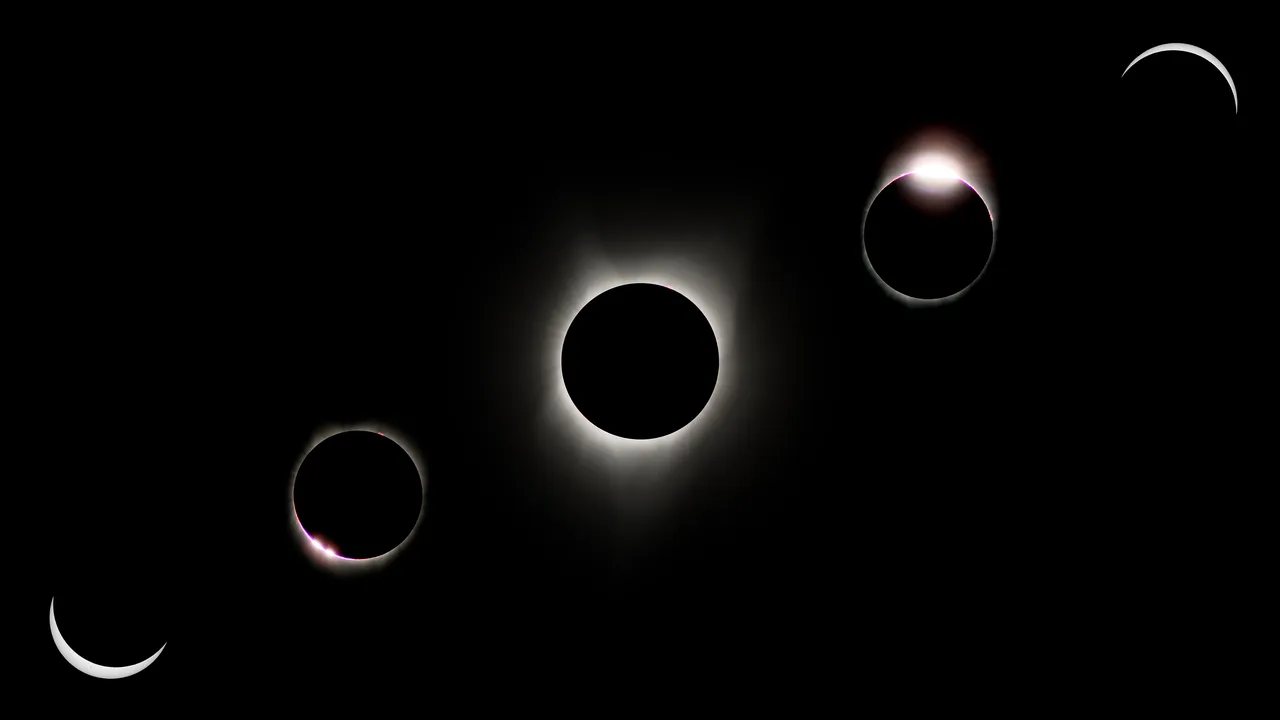
Are you as excited about the 2026 solar eclipse as we are? I’m sure you are! The first of the trio of eclipses with privileged visibility in Spain is just around the corner and surely you haven’t stopped seeing reminders and notices of this highly anticipated astronomical phenomenon in your social media feed. But do you know why eclipses happen? Why will it be visible better from some parts of Spain than from others? What types of eclipses exist and how can you tell them apart?
To help you enjoy the 2026 solar eclipse (more than 100 years since the last total solar eclipse on the Iberian Peninsula) as it deserves, we have prepared a list of common questions about eclipses that will help you understand this historic event which is both magical and scientific, and to protect yourself properly.
Go to:
Why do eclipses happen?
Types of eclipses
Diamond ring and Bailey’s beads: this is what you see during a total solar eclipse
Why doesn’t the eclipse look the same across all of Spain?
Why aren’t there eclipses in every lunar cycle?
Lunar eclipse: why it happens and how it looks
Other types of eclipses: Mercury and Venus transits
A finite spectacle: why at some point there will be no more total eclipses on Earth
Precautions and tips for viewing the solar eclipses of 2026, 2027 and 2028
Why Do Eclipses Happen?
In very few words, an eclipse happens when a celestial body interposes itself between the Sun and another, and casts its shadow on the latter. By the arrangement of our solar system, there can be two types: a solar eclipse, in which the Moon interposes between the Sun and the Earth and blocks the Sun’s light, and a lunar eclipse, in which the Earth interposes between the Sun and the Moon and projects a filtered light onto our satellite.
Types of Solar Eclipses
There are four types of solar eclipse: the total, the annular, the hybrid, and the partial.
- The total eclipse is the one in which the Moon perfectly covers the Sun, and is accompanied by a sudden darkening of sunlight and a drop of several degrees in temperature. During this event you can see a halo of diffuse light that seems to emanate from behind the lunar disk. The total eclipse can last from a few seconds to several minutes (the theoretical maximum is around seven minutes) at a given location, while from other areas what you see is a partial covering of the solar disk (like a “bite”).