Ireland’s west coast has a habit of making famous places feel inevitable. The Cliffs of Moher appear on postcards and almost every first-time visitor’s wish list. Yet far to the north, on County Donegal’s Atlantic edge, Sliabh Liag rises on a scale that makes that landmark feel unexpectedly modest. The surprise is not only the height. It is that a landscape this immense can remain outside so many journeys, passed by travellers who never realise what waits beyond the next turn.
Donegal’s giant above the Atlantic
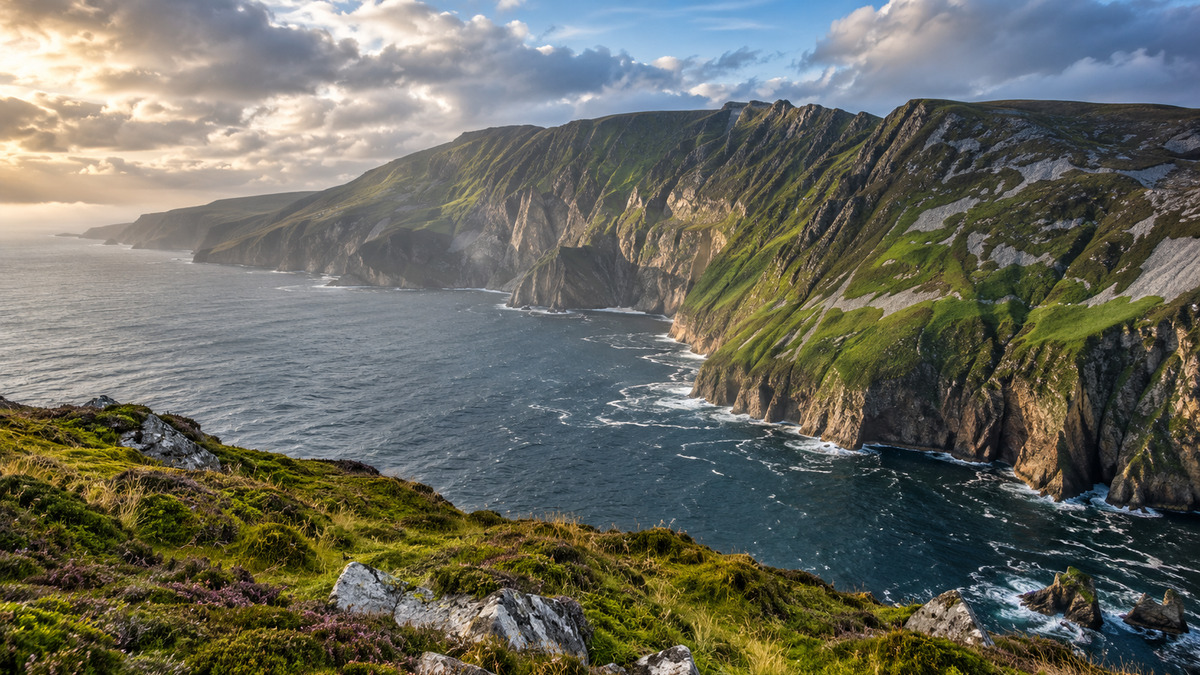
Sliabh Liag, also widely known as Slieve League, does not reveal itself like a single theatrical wall. The coastline builds gradually: open moorland, scattered houses, narrow roads, a flash of ocean and then an enormous sweep of rock and grass dropping toward the water. From an established viewpoint, the cliffs seem to continue in layers, each ridge fading into sea mist.
Their highest ground is often described as reaching close to 600 metres, while the best-known sections of the Cliffs of Moher rise a little above 200 metres. That is where the striking “almost three times higher” comparison comes from. It refers to maximum elevation rather than suggesting that every section is a sheer vertical face. Even with that distinction, the scale is difficult to absorb until the boats below look tiny and the Atlantic appears less like scenery than a vast moving surface.
Height alone is not the whole experience. The Donegal setting feels broader, quieter and more exposed. There is no need for a dramatic stunt or a precarious photograph. The view is powerful from safe, established areas, where distance makes the folds of the cliffs easier to understand.
Why so many visitors miss the turn
County Donegal rewards travellers who allow extra time, but it is rarely a quick addition to a tightly organised tour of Ireland. Many routes concentrate on Dublin, Galway, the Burren and Kerry. Even people driving the Wild Atlantic Way can underestimate the northwest, deciding that Donegal is “too far for this trip” or leaving it for a future visit that never quite happens.
Sliabh Liag also sits beyond the kind of road where a landmark announces itself from miles away. The journey moves through a lived-in rural landscape rather than a corridor designed around one attraction. That understated approach is part of the pleasure. The cliffs arrive as a revelation, not as the final stop in a long line of billboards and souvenir signs.
There is also a curious effect created by fame. Once one set of cliffs becomes the Irish cliff experience in the public imagination, alternatives can sound secondary. Here the reverse is true: the lesser-known place is the one with the greater physical scale, while the famous name continues to dominate travel plans.
A landscape that changes by the minute
The Atlantic weather gives Sliabh Liag much of its character. Sunlight can pick out green ledges and pale seams of rock, then disappear behind cloud before the eye has finished tracing them. Mist may soften the far ridges; a clear interval can suddenly open a long view along the Donegal coast. The same scene can feel bright and spacious, then severe and ancient, within a short span.
That changeability deserves respect. Cliff edges, wind and poor visibility are a serious combination. Visitors should remain on established routes and viewing areas, keep well back from exposed edges and be prepared to abandon a walk when conditions deteriorate. Sturdy footwear and an extra layer are sensible even when the day begins calmly. The most memorable visit is not the one that pushes furthest, but the one that leaves enough attention for the landscape itself.
The detour that reshapes an Irish road trip
Sliabh Liag changes the mental map of Ireland. It shows how easily a celebrated route can leave its largest surprise outside the standard frame. The reward is not the satisfaction of saying one landmark is “better” than another. Moher has its own drama, accessibility and unmistakable profile. Donegal offers something different: space, scale and the feeling of discovery.
For travellers who have time to continue northwest, the cliffs can become the moment around which the rest of the journey is remembered. The road may feel longer, the weather less predictable and the landscape less polished. That is precisely why the arrival carries such force. Ireland’s most famous cliffs may start the conversation, but these quieter Atlantic heights can completely change it.