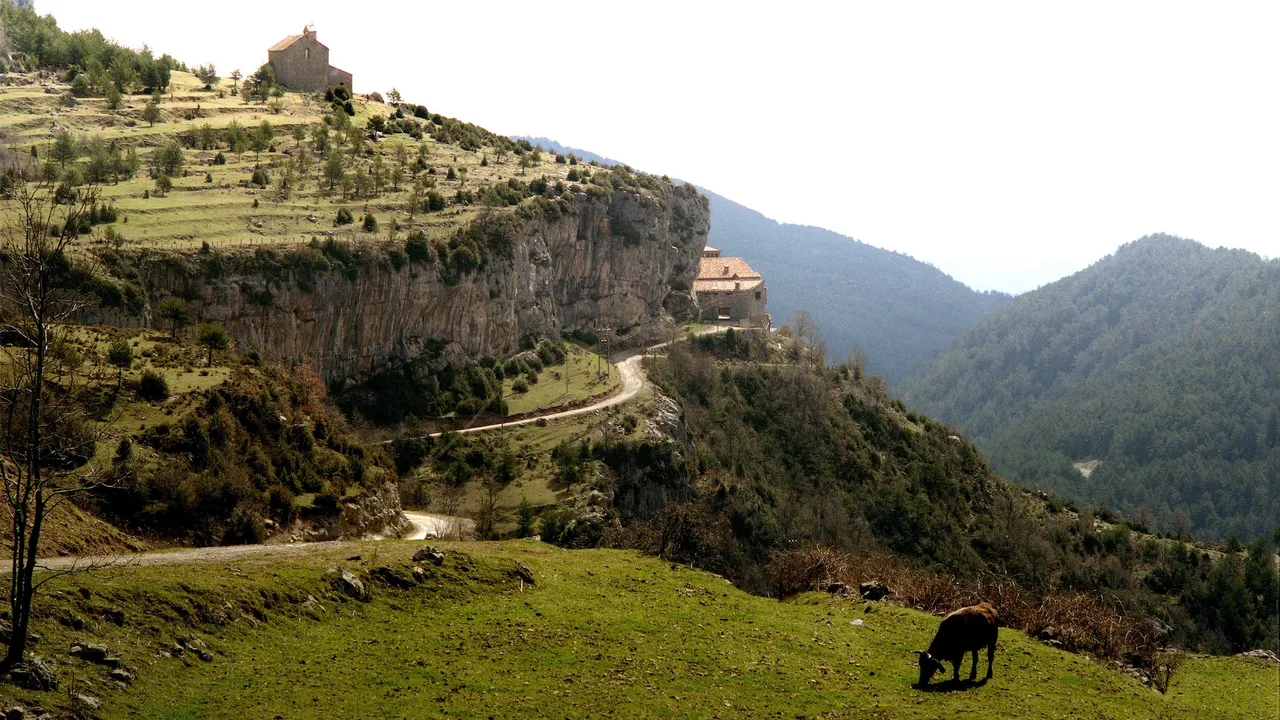
In the Ripollès comarca, at the heart of the Catalan Pyrenees, the mountain municipality of Gombrèn opens its doors to rural life with a grand landscape, a nature to be enjoyed at a relaxed pace, and a commitment to sustainability and craft that is realized through medicinal plants.
We set out on a healing journey toward a destination little known but rich with ingredients to fall in love with.
A Gift in the Merdàs River Valley
With the Montgrony, Puigbò and Sant Marc ranges as visual references and the Merdàs River valley as the gateway to this part of the Catalan Pyrenees in the province of Girona, we arrive at a municipality whose roots reach back more than a thousand years.
It is the territory of the famous Count Arnau, whose legend is among the most symbolic and identity-forming stories for both the Ripollès comarca and medieval Catalonia. Here we first focus on the Castle of Mataplana, the epicenter of the life of this prominent figure in local and Catalan culture, who, according to tradition, was condemned to wander for all eternity to atone for his many sins.
To the legendary noble, oral tradition over time transformed him into an archetype of the sacrilegious tyrant. His ghostly image, linked to his mount—a black horse that spews fire from its eyes and mouth—and to a pack of hellhounds, is a recurring tale among locals, and several nearby sites are linked to his figure, such as the Gorg dels Banyuls, a beautiful water basin that, though an idyllic natural corner, is connected to the spot from which the Count Arnau’s soul leaves each night.
The best place to learn about the noble’s myth is none other than the Count Arnau Museum, housed in the town’s cultural center in Gombrèn, where it is also possible to see numerous pieces and objects recovered from the excavations of Mataplana Castle.
This settlement, home to barely a few hundred inhabitants, is the municipality’s main center. It is a network of houses, with the Church of Sant Pere as its principal stronghold, which still preserves its medieval essence, with an old section that retains the appearance of a fortified village from the past.