We love summer, but there is something truly special about those early days (and nights) of autumn: the temperatures cool down; the thrill of summer shifts into that “back to school” feeling, which is sometimes literal and sometimes metaphorical; the lively, frantic energy becomes introspective and spiritual, and we are seized by the sense that the moment has arrived to reap the fruits of our year’s efforts. And what better herald of that spirit than the harvest moon, which this year lands just after the seasonal shift, on September 26. Read on and we’ll tell you how to enjoy the first full moon of fall in all its glory.
What is the harvest moon?
The full Moon that comes closest to the autumnal equinox, usually appearing in September, is known as the harvest moon, though in some places it is also called the “corn moon” or “the harvest moon” (depending on local naming customs). This evocative name seems to stem from agricultural life: at the end of summer, as several crops ripen simultaneously, farmers needed to stretch their working hours into the night, and before the advent of electric light, moonlight was essential for this task. The harvest Moon, which tends to look bright and low on the horizon on clear nights, was ideal for adding a few extra hours of work after sunset. But it isn’t the only full Moon with a popular name—each month has its own designation: the Wolf Moon (January), the Snow Moon (February), the Worm Moon (March), the Rose Moon (April), the Flower Moon (May), the Strawberry Moon (June), the Buck Moon (July), the Sturgeon Moon (August), the Harvest Moon (September), the Hunter’s Moon (October), the Beaver Moon (November), and the Cold Moon (December).
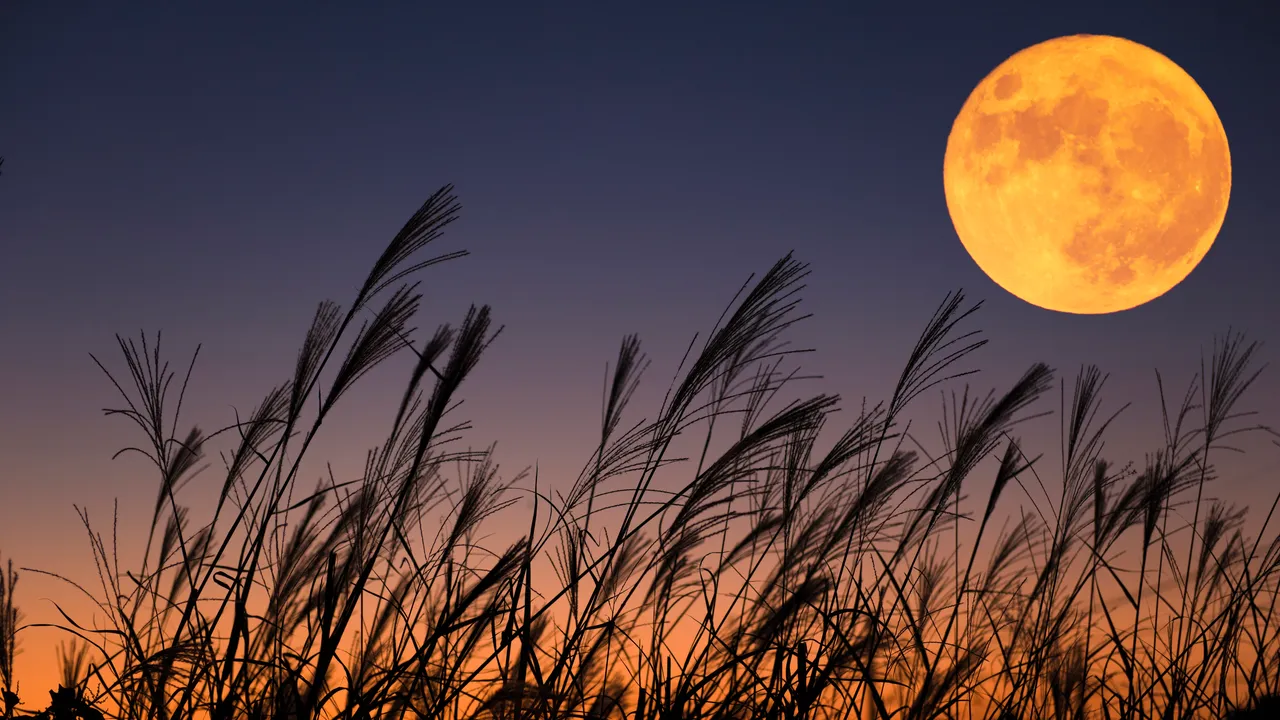
What makes the harvest moon so special, then? Typically, this Moon—along with October’s full Moon—tends to appear larger than usual (even when not a supermoon), and takes on an orange or yellowish tint as it rises, as if lifted from a Tim Burton film. This effect is tied to the Moon’s rising time: for most of the year, the Moon rises about an hour later each day, but those intervals shrink around the autumn equinox. During this period, the difference in rising times from day to day is about half an hour or less, so the Moon appears to rise at nearly the same time each day. Moreover, at this time, full Moons occur at sunset, so as the Sun sets we can see the Moon near the horizon. This makes it look much larger due to a phenomenon known as the lunar illusion. The colors are the result of the atmosphere, which scatters blue light and allows reddish tones to reach the observer’s eye.
This Moon holds particular significance in East Asian cultures. The second most important festival in the Chinese lunar calendar is the Mid-Autumn Festival, which has its equivalents in Japan’s Tsukimi, Korea’s Chuseok, and Vietnam’s Tết Trung Thu, each with its own traditions, legends, and even foods, but all deeply shaped by a spirit of sharing with loved ones, celebrating childhood, and seeking good fortune from the Moon.