London, which never ends, holds as many journeys within it as there are people. You can explore its most bohemian side in Fitzrovia, its most typical face. It can be walked with friends, with children, or with babies, and you can always make the most of it.
But today we focus on its contemporary architecture. The buildings built in recent years, the ones that still do not appear in travel guides. They may not shout, but they define the spirit that any city should embrace: localized, authorial, with meaning. With projects far from obvious, yet acclaimed by critics, those that make us turn our gaze and ask: “What did I just see?”
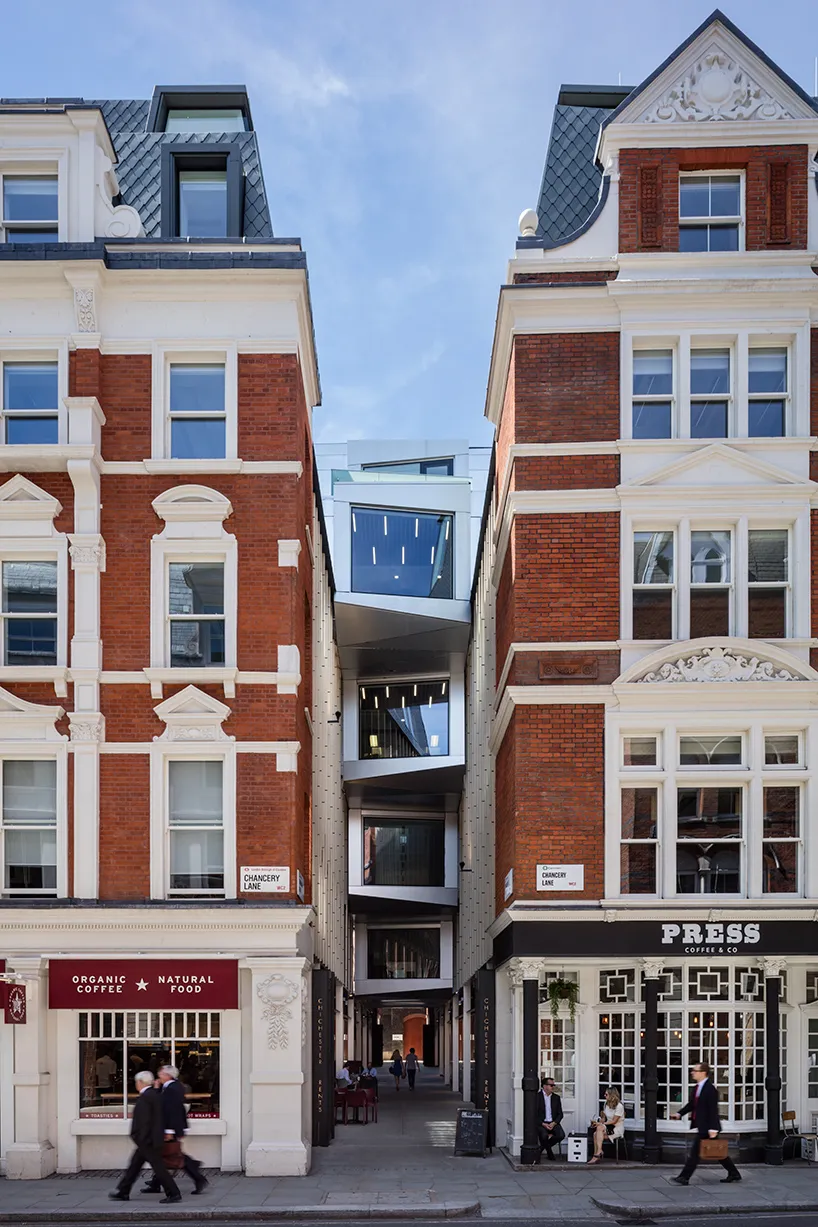
Chancery Lane, by Orms Architects
That inevitable “What did I just see?” occurs in Chancery Lane: you’ll have to walk past twice to grasp what’s happening with that jewel-like building that climbs between two Victorian structures. Its metal facade, catching the sun, sketches a changing reflection throughout the day that makes the space glow in new ways each day.
What Orms Architects actually do, however, goes beyond a mere architectural trick: with their intervention, they manage to transform a forgotten and little-used passage into a new facility that strengthens the connection with Bishop’s Court. And (here’s the finesse) they achieve it with a rare balance that does not erase the historical, but instead coexists with it with its own spirit, displaying modernity without caveats, yet also without incongruous contrasts.
The intervention also includes the reform of the ground-floor facades of the old buildings, where new shops have been introduced that energize the landscape. It is a key part of a project that has revitalized the area and made the most of the space in a city as densely built as London.
As you stroll through it, by the way, you’ll come across other projects by the studio. Such as One Newman Street, which you’ll recognize by its copper-patinated curved screens and its broad rounded and glazed corner, which, paying homage to Orms’ practice—so respectful of the landscape—references the numerous commercial corners topped with towers along Oxford Street.