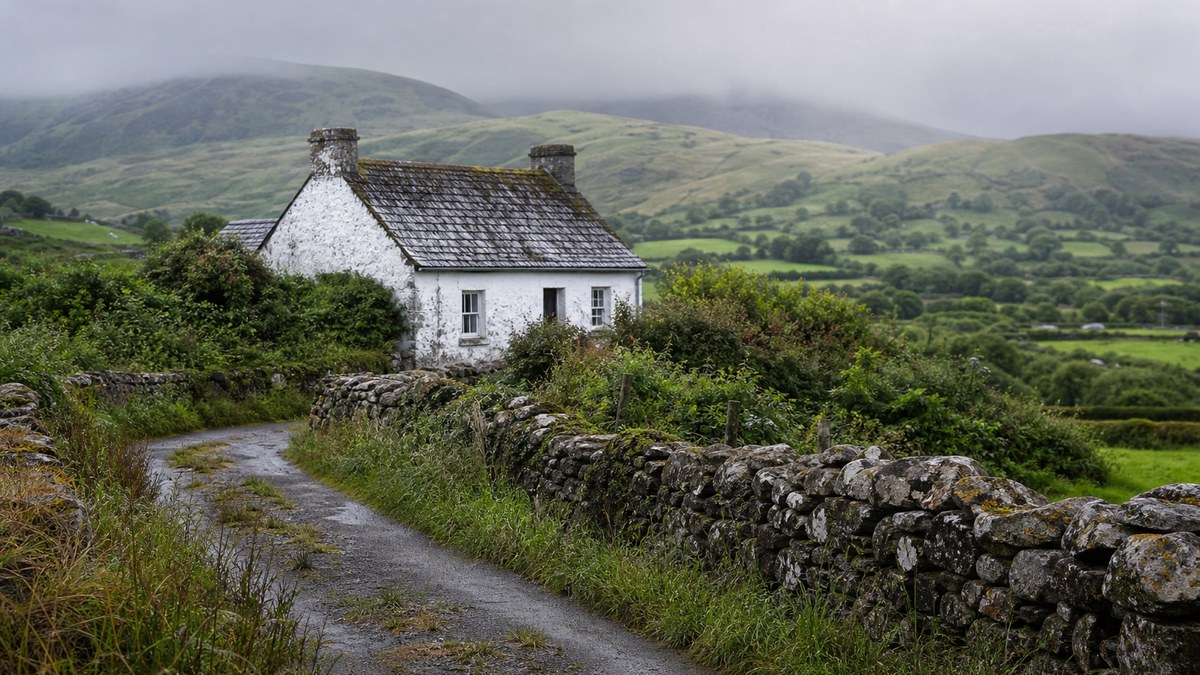
There are places in Ireland where the road seems to slow down by itself. A bend appears, a stone wall runs beside a field, a weathered cottage sits under a wide sky, and for a moment the noise of the modern trip falls away. Visitors often race from one famous stop to another, but the most memorable parts of the island are sometimes found between the pins on the map.
In parts of rural Ireland, especially around the quieter western and northern roads, whole pockets of landscape still feel untouched. Not empty, not staged, not made for postcards, but lived in at a different speed. As one local guide puts it, “People come looking for Ireland and sometimes pass it at eighty kilometres an hour.” That sentence says a lot.
The places between the famous stops
The charm is not always dramatic. There may be no cliff edge, no giant car park, no visitor centre and no obvious sign telling people to stop. Instead, there is a lane bordered by mossy stone, a churchyard with old names, a small bridge over brown water, or a pier where two boats knock softly in the wind.
These corners survive because they are not easy to sell as a single attraction. They are not “must-see” in the usual travel language. They are better experienced slowly, with room for silence and patience. “You have to give a place time to introduce itself,” says a guesthouse owner who often sends travellers away from the busiest routes.
That advice can sound simple, but it changes the trip. A short detour becomes a memory. A village shop, a quiet cemetery or a view across wet fields can feel more personal than a landmark shared with thousands of people that same day.
Why visitors miss them
Modern travel makes movement easy and attention scarce. People build itineraries around famous names, then judge the day by how many boxes they ticked. Ireland encourages that behaviour because its headline landscapes are genuinely spectacular. The problem is that the in-between places disappear from view.
Car hire, GPS routes and social media all push visitors toward the same handful of stops. If a road looks narrow or if there is no obvious parking, many keep driving. Yet those small hesitations are often where the more authentic experience begins.
- old fishing harbours without souvenir shops;
- lanes where sheep still interrupt the traffic;
- villages where the pub is also the local noticeboard;
- ruined cottages that hint at harder chapters of history.
None of this needs to be romanticised. Rural life has its difficulties, and not every quiet place is a museum. But that is exactly why these corners feel powerful. They are not frozen because nothing happens there. They feel frozen because change arrives more slowly and leaves more traces behind.
A different kind of Irish journey
The best way to notice these places is to leave space in the day. One fewer attraction, one longer pause, one road chosen because it looks interesting rather than efficient. The reward is not always immediate, but it is often deeper.
Travellers who do this may find a conversation at a petrol station, a church ruin behind a hedge, a beach with no one else on it, or a line of cottages facing the Atlantic as if time had simply forgotten to hurry. “The quiet road tells you more than the busy viewpoint,” says a photographer who has spent years working along Ireland’s smaller routes.
For anyone planning a trip, the lesson is clear: the island is not only in its famous landscapes. It is also in the pauses, the low walls, the ordinary villages and the stretches of road people barely remember passing. Sometimes the place that stays with you is the one you almost missed.