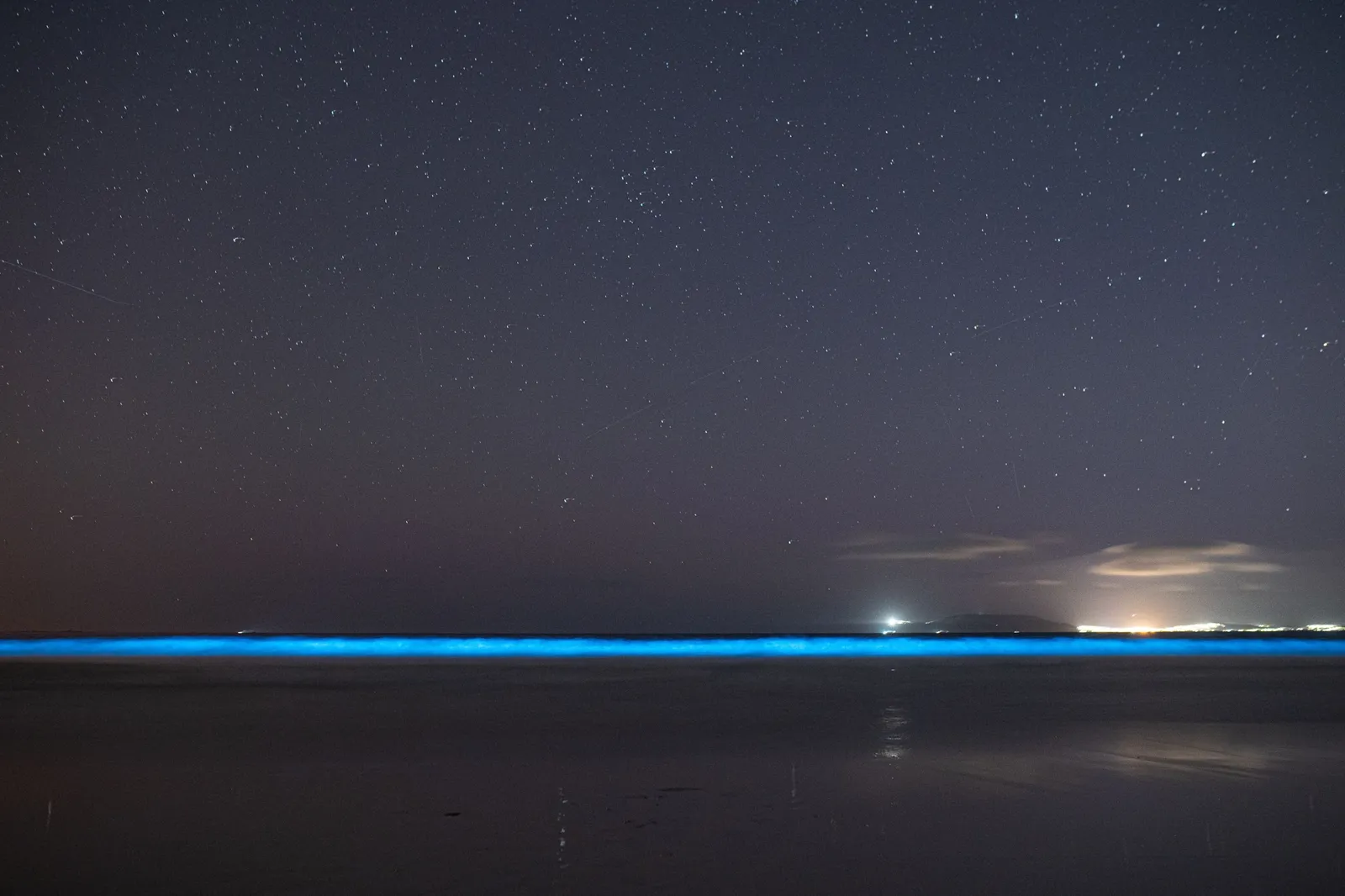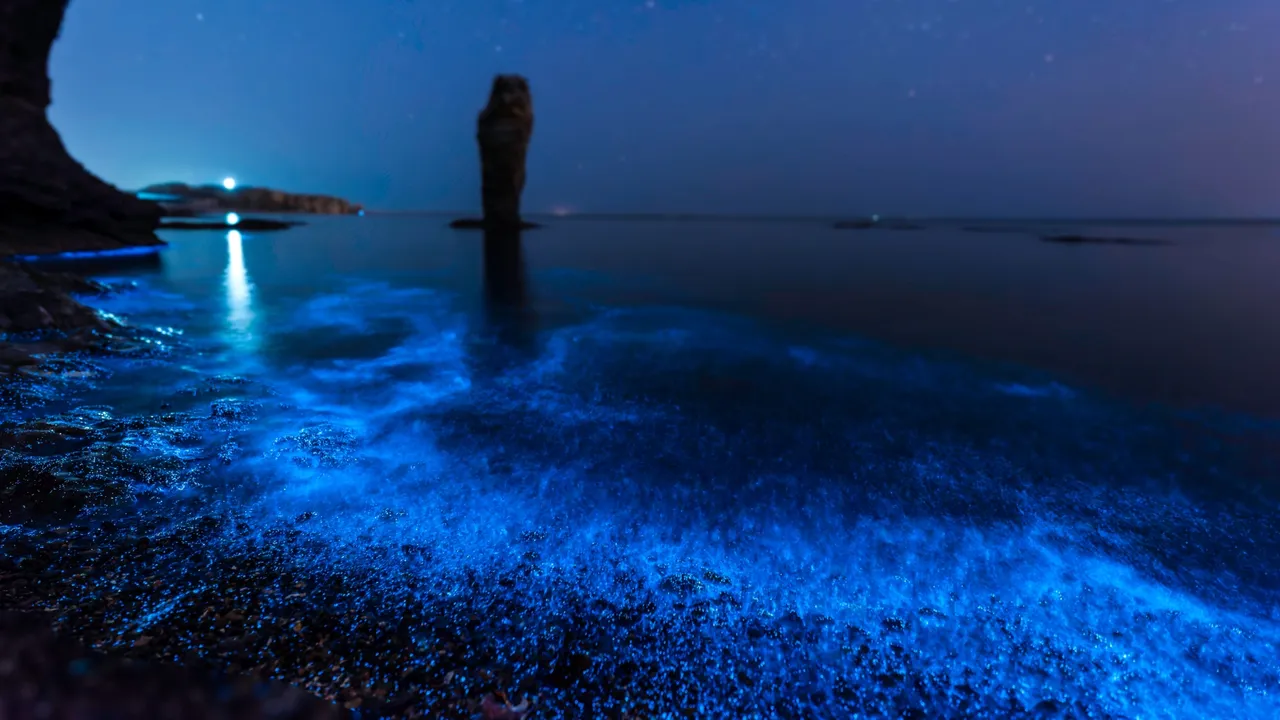
If you remember those summer nights when you used to go out to catch fireflies, you might imagine—or approach the idea of touching stars in the sea. It isn’t science fiction, and it has its own name: Ardentía or Sea of Ardora. And bathing in it is the summer’s challenge.
What is this phenomenon and how does it occur?
Nature is astonishing. Even more so when we focus our attention on phenomena such as bioluminescence, a fascinating capability that allows certain organisms to emit cold light by transforming chemical energy into luminous flashes with astonishing efficiency and without generating heat.
Bioluminescence is far more common than we imagine. If you come across such a display at night on the beach, don’t think of radioactive waves or anything like that: there are only millions of unicellular microorganisms that glow in the water when disturbed by the movement of the waves.
The richness of the Galician coasts allows millions of nutrients to accumulate in their waters, and among all this diversity appears the species Noctiluca scintillans, whose etymology means “that shines at night,” more commonly known as “sea spark.” These noctilucas, which sometimes surface on beaches, can be seen with the naked eye during the day because they leave orange stains in the water.
Diverse oceanographic and biological studies explain that this flash is produced by the reaction between a molecule called luciferin and oxygen, catalyzed by the enzyme luciferase. When movement or vibration occurs on the water’s surface (by the swell, a swimmer, or the passing of a boat), oxygen enters contact with luciferin, releasing blue photons, especially noticeable at night.