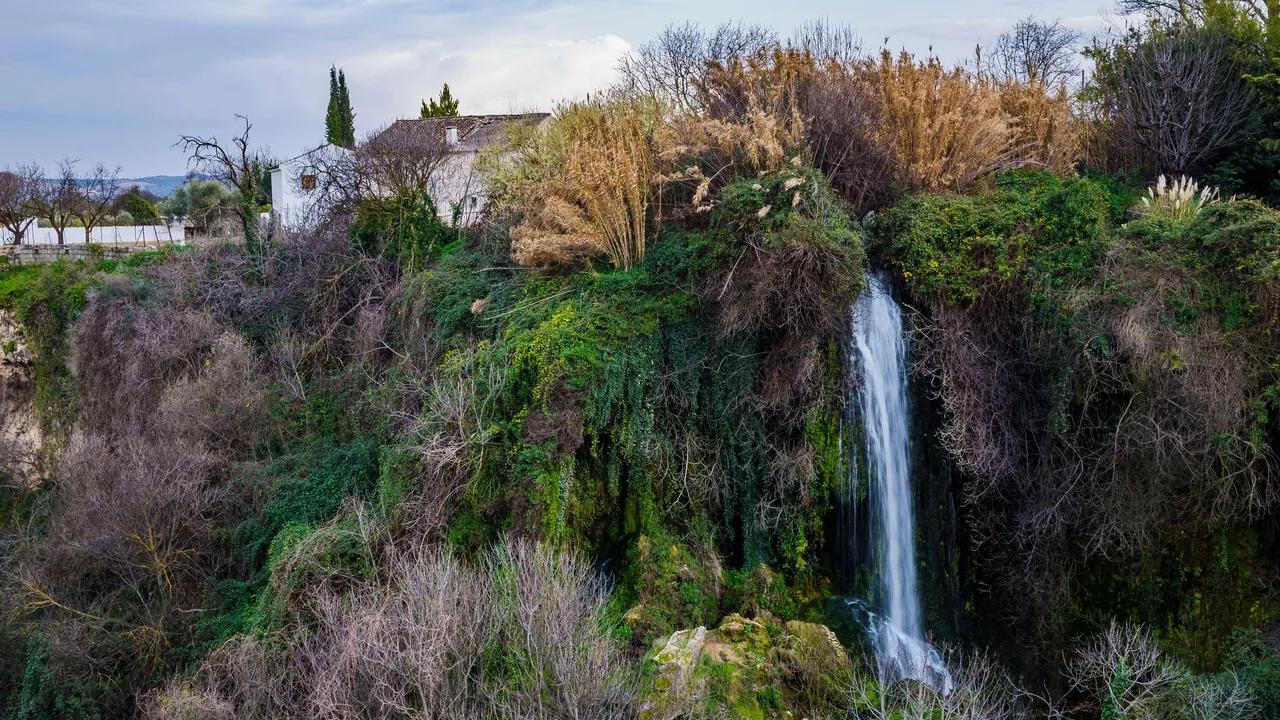
Where the Genil River breaks the calm of the Vega of Granada and is squeezed between limestone walls, there exists a striking landscape that seems drawn from a dream, a geological dream come true within the Natural Monument of Los Infiernos de Loja, a protected space that dazzles with its waterfalls, its rapids, and its travertine formations.
A landscape carved in stone
In the heart of the Poniente Granadino region, in an old land of borders marked by the course of the Genil River, a fantastical-looking landscape appears before us, shaped over centuries by the patient erosion of water on rock.
We find ourselves a very short distance from the town of Loja, about ten minutes by road from the town center of the Andalusian settlement. As soon as we leave the asphalt and take a path that leads toward the Natural Monument, we begin to hear the roar of the water dominating the atmosphere. As we approach, that murmur grows louder until it asserts itself. We have reached the Genil River’s course, which at this point is encased between elevations and ravines, whose waters advance with a force whose name only can adequately define: the Infernos.
Here nature has transformed the rock into something akin to an architectural work, through which a stretch of river experiences passage in one of the most singular geological spaces in all of Andalusia, creating a wild natural corner where nature expresses itself freely for the enjoyment of anyone who dares to stray from the path to reach this point.
It is hard to believe that one of the most stunning landscapes in the interior of Andalusia remains relatively unknown beyond the region, though this very fact is its greatest charm, together with the magnificent work of natural engineering performed by the Genil River as it carves ravines where erosion and sedimentation reveal their vocabulary of beauty, with beautiful cascades such as Cola de Caballo and travertine formations acting as striking features.
The allure of the travertines
The Los Infiernos de Loja landscape stands out for many reasons, but there is one feature that makes it truly peculiar. We are talking about the shapes created by deposits of calcium carbonate precipitated from the water. The so-called ‘travertines’ are real sculptures wrought by the moving liquid, delicate mineral formations that produce highly striking geological features and turn this natural space into an open-air natural laboratory.