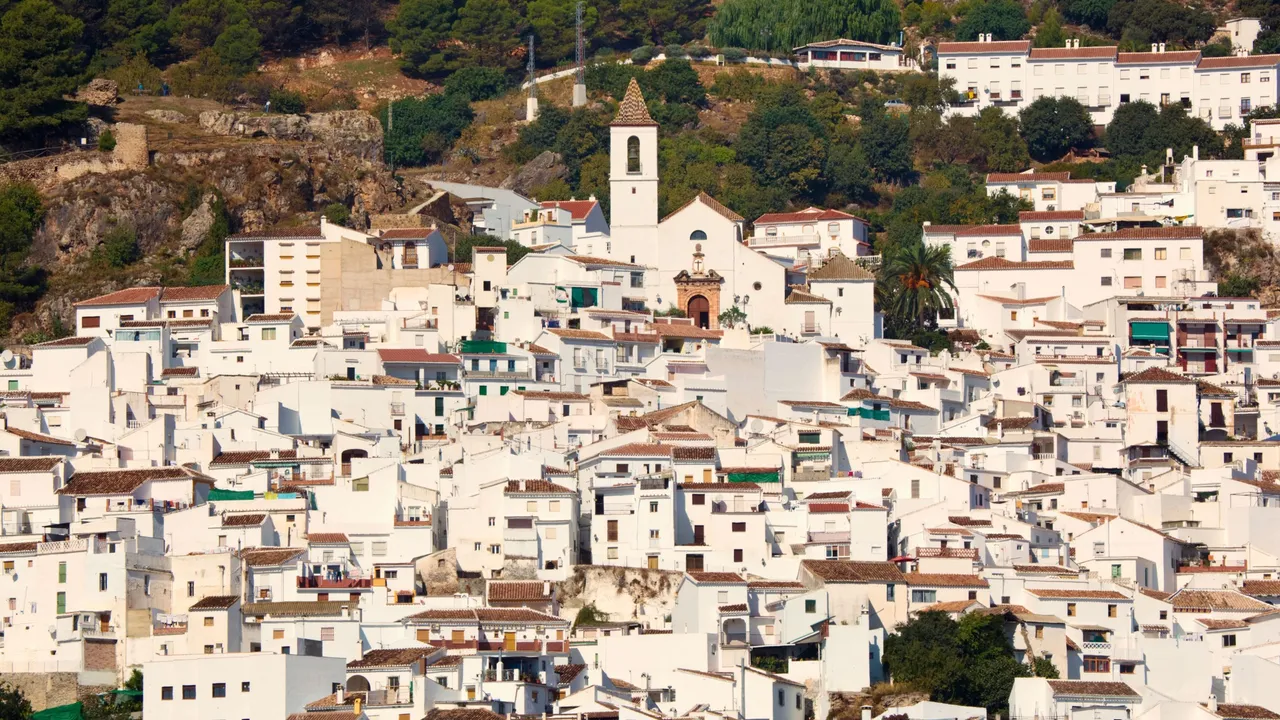
The essence of Andalusia’s white towns is displayed in full splendor in this intriguing mountain town perched in a privileged location. Its identity, its surroundings, and its excellent gastronomy invite us to discover Casarabonela.
The heartbeat of the Sierra de las Nieves
In the heart of Málaga province, tucked away in a landscape of rugged relief whose image bears little resemblance to the province’s tourist coastal strip, Casarabonela appears, far from the bustle and with the purest essence of the Andalusian mountain towns.
Encircled by mountains, with the influence of the Guadalhorce valley and integrated within the Sierra de las Nieves National Park—also designated a UNESCO Biosphere Reserve—, it is a town with Roman and Arab heritage, whose municipal area holds landscapes of striking contrasts, ranging between the rugged reliefs and the fertile orchards laid out on terraced slopes. The main nucleus, perched on the slopes of the Sierra Prieta, commands expansive views.
The whiteness of the limewashed houses stands out from afar, and the labyrinth of narrow streets and small plazas, in Moorish style, creates an unmistakable image, especially if we focus on the Arrabal neighborhood, next to the alcazaba—an important bastion in that era and an excellent lookout today—which is the best preserved of that heritage. Under the alcazaba, at one end of the town and flanked by a thick wall, we find a charming corner full of charm: the Andalusian Garden, at the foot of the ancient Arab fortress, a recreation of those small orchards with tree species and aromatic plants that filled living spaces with fragrances and beauty.
Meanwhile, at the foot of the town, the orchards extend, giving way immediately to the trails that lead to crops and Mediterranean vegetation. Precisely from one of these trails we can reach, even on the outskirts of Casarabonela, the indispensable Mora i Bravard Botanical Garden, which houses one of the most important collections of cacti and succulents in Europe and the largest of Spain of these plants. Opened in 2011 with a cactus-themed focus, it was the partnership formed by Joan Mora and Edwige Bravard that eventually developed this exceptional botanical garden with hundreds and hundreds of different succulent species.