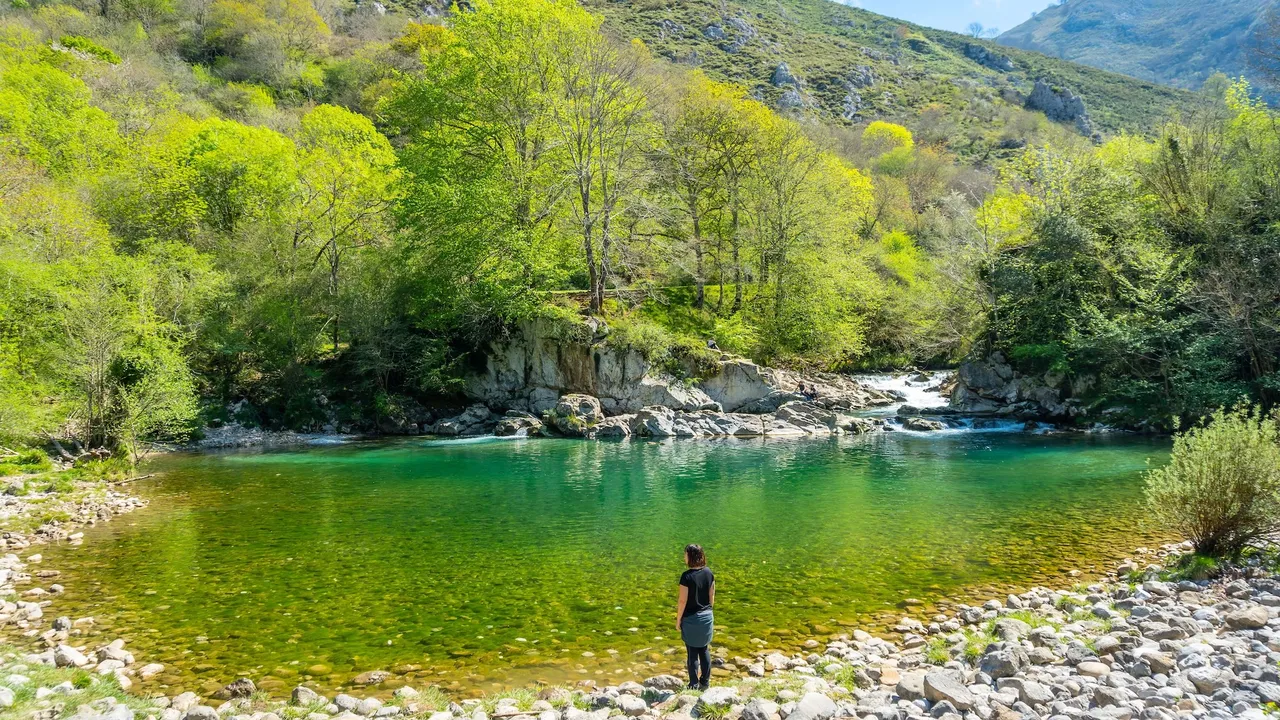
Straddling the councils of Cangas de Onís and Amieva, in the eastern part of the region, begins one of the most well-known and emblematic routes among the Asturian population, a journey along the Dobra river that leads to a natural pool of emerald-green waters: The Olla de San Vicente.
An extraordinary place that remains unknown to many people outside Asturias.
Un rincón para sorprender
Cangas de Onís, the famous town that was the first capital of the Kingdom of Asturias and one of the Principality’s most important tourist icons, with the image of its Roman Bridge and the faithful reproduction of the Cross of Victory hanging from it, provides a reference point for reaching one of the region’s most beautiful natural spots.
Only six kilometers from Cangas de Onís, at a point on the road that links Arriondas with the province of León, there is an entry where the Olla de San Vicente trail begins, just a few dozen meters from the point where the Dobra river joins with the Sella.
A short, easy-to-execute stretch that, precisely for this reason and for its great appeal, is a superb choice to immerse ourselves in the Asturian riverside nature if we find ourselves in this area, so focused on the presence of other nearby places as important as Cangas itself or the Sanctuary and the Covadonga Lakes.
The walk takes us along a path beside the Dobra River, with the riverside forest sheltering us from the sun’s scorching rays during the hot months of the year. Little by little we move forward until we reach the time-worn medieval bridge with a single arch, an unmistakable emblem of the area and a historic luxury for those who traverse it, since part of its surface is made up of slabs that were part of the ancient Roman road that passed through these landscapes.
From there, resuming the journey and with the murmur of the water accompanying us at every moment like a natural soundtrack, we reach without getting lost the Olla de San Vicente, a large natural pool whose water color is hypnotic at first sight. A pool several meters deep that, however, thanks to the water’s transparency, allows the sun’s rays to pierce to the bottom, illuminating it and enhancing in refraction the greenish-blue tones that undoubtedly characterize this corner of inland Asturias.